You followed the recipe exactly. Rinsed the rice, measured the water, set the heat to low, covered the lid. Fifteen minutes later, scorched grains welded to the center of the pan and a dry crust on top. Sound familiar?
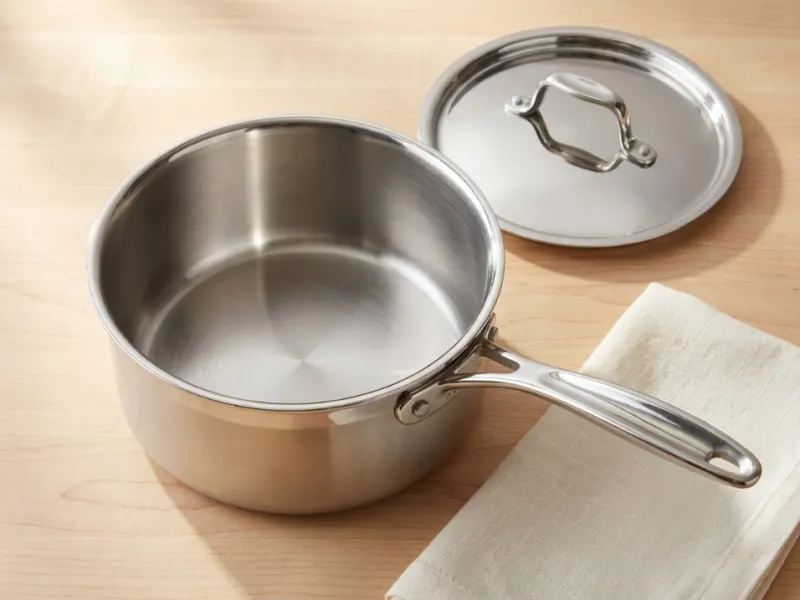
The best pan for rice is a fully clad tri-ply saucepan with a tight-fitting lid. The Cuisinart Multiclad Pro 3-Quart Saucepan uses triple-ply construction (stainless/aluminum/stainless) that spreads heat across the entire base and up through the walls, eliminating the center hot spot that burns rice in cheaper pans.
We pulled r/cookware threads, Amazon long-term reviews, and six years of owner reports on the MultiClad Pro line, and the pattern held every time: stovetop rice is not a technique test. It is a heat-distribution test. Your pan either passes or fails, and no amount of water-ratio adjustment fixes a pan that fails.
Why Rice Burns in Most Saucepans#
Stovetop rice uses the absorption method. Water heats, gets absorbed by the grains, and steam finishes the top layer. For the duration of that low simmer, your pan needs to deliver uniform heat across every square inch of base.
A thin saucepan or a disc-bottom design (where a thick aluminum disc is welded to the bottom only) concentrates heat directly above the burner element. The center reaches a higher temperature than the edges. Owners across r/cookware and Amazon reviews describe the same frustration: rice scorching at the center while the edges stay underdone.
That is not technique failure. The pan physically cannot spread heat laterally because there is no conductive material running through the walls.
A fully clad saucepan fixes this by sandwiching an aluminum core between stainless steel layers all the way from the base up through the sidewalls. The aluminum conducts heat sideways before it reaches the cooking surface. Stephen La Rosa, a professional chef who has used the Cuisinart MultiClad Pro set for over six years, describes conventional cheap pans as producing "a lot of weird hot spots" with noticeable temperature swings in his YouTube review of the set. The tri-ply construction eliminates that entirely.
The Rim Check (How to Tell What You Have)#
Here is a test you can do right now with the saucepan in your cabinet. Look at the edge of the rim where the metal is exposed.
- If you see distinct layers of metal bonded together (a sandwich visible at the lip), your pan is fully clad. Heat runs through those layers from base to rim.
- If the rim looks like a single sheet of steel with no visible layering, it is disc-bottom. The aluminum is only at the base, and the sidewalls are cold.
That distinction matters more for rice than any ratio adjustment or timing trick. A fully clad pan on the lowest setting delivers genuinely uniform heat. A disc-bottom pan on the lowest setting still concentrates it at the center.
Why We Recommend the Cuisinart MultiClad Pro#
The Cuisinart Multiclad Pro 3-Quart Saucepan (model MCP193-18N) uses the same triple-ply fully clad construction that defines premium stainless cookware. The aluminum core runs from the base up through the sidewalls, delivering even, predictable heat at every point the rice touches.
Amazon buyers rate it 4.7 out of 5 across over 7,000 reviews. Across those reviews and long-term YouTube reports, owners consistently praise even heating and report no warping or delamination. That durability matters because a warped base creates the same hot-spot problem on glass-top stoves that a disc-bottom pan creates everywhere.
The 3-quart capacity handles standard weeknight batches comfortably. The stainless lid fits snug with no steam vent, keeping moisture cycling back into the rice during the absorption phase. That sealed environment is what separates fluffy individual grains from a dry top layer.
The One Tradeoff Worth Knowing#
Stainless steel is not nonstick. Rice will occasionally stick if you skip the resting step.
After the timer goes off, remove the pan from heat and let it sit covered for a few more minutes. That resting period lets the grains release from the hot surface on their own. Skip it, and you will be soaking the pan afterward.
That soaking fix is easy. Fill the pan with warm water, let it soak, and stuck grains release without scrubbing. The surface itself cannot scratch, warp, or degrade from cleaning.
Unlike a nonstick saucepan whose coating eventually degrades under regular use, a fully clad stainless saucepan has no coating to wear out. There is nothing between the metal and the food to eventually fail.
You can run the per-year math on the cookware cost calculator to see how a mid-range stainless saucepan compares against replacing budget nonstick every two years.
When Nonstick Makes More Sense#
If you cook rice daily and want zero cleanup friction, we will admit a nonstick saucepan avoids sticking entirely. The tradeoff is lifespan. Nonstick coatings degrade under regular use, and a thin aluminum body underneath brings back the same hot-spot problems we described above. For someone who cooks rice once or twice a week and values longevity, a fully clad stainless saucepan outlasts multiple nonstick replacements.
The material selector quiz can help you weigh convenience against durability for your specific cooking frequency.
The Method That Works on Any Stovetop#
The right pan does most of the work. Here is the straightforward method:
- Rinse rice until water runs mostly clear (removes surface starch that causes clumping)
- Add rice and water to the saucepan
- Bring to a full boil uncovered
- Drop to the lowest heat setting your stove offers
- Cover with the lid and leave undisturbed until the water is fully absorbed
- Do not lift the lid (every lift releases steam the top layer needs)
- Remove from heat, keep covered for a few more minutes
- Fluff with a fork
This works the same on gas, electric coil, glass-top, and induction because the fully clad construction handles all of them evenly. The difference between this and what you have been doing is probably nothing except the pan itself. That is the point. When the pan spreads heat properly, the simple method just works.

If rice does stick, a quick cleanup approach handles it without scratching the surface.