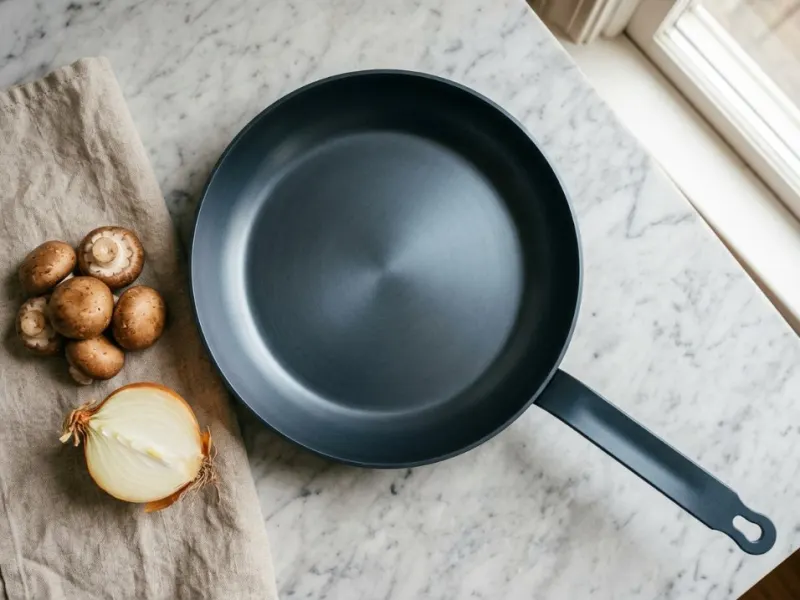
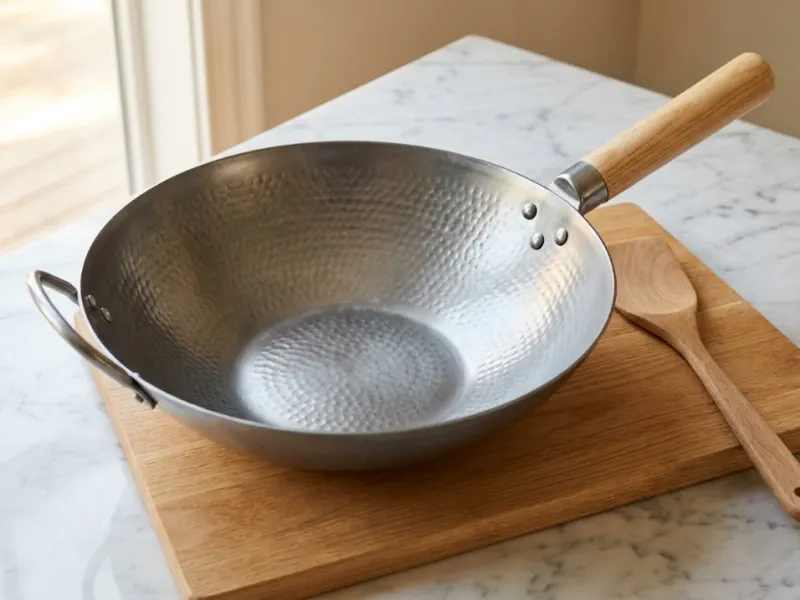
We kept seeing the same question across r/cookware and Amazon reviews: why do nonstick pans die so fast when you sear on them? So we pulled the manufacturer care documents and the research data to find out where the actual line sits.
Tramontina's care instructions state "USE ONLY LOW TO MEDIUM HEAT" in bold capitals, and every major PTFE brand echoes that guidance. Searing demands heat settings above medium. Every session past the rated range shortens what was already a limited lifespan.
The best pan for high heat cooking is one without a synthetic coating. Carbon steel gives most home cooks the best combination of searing performance and manageable weight, with a surface that improves over time instead of degrading.
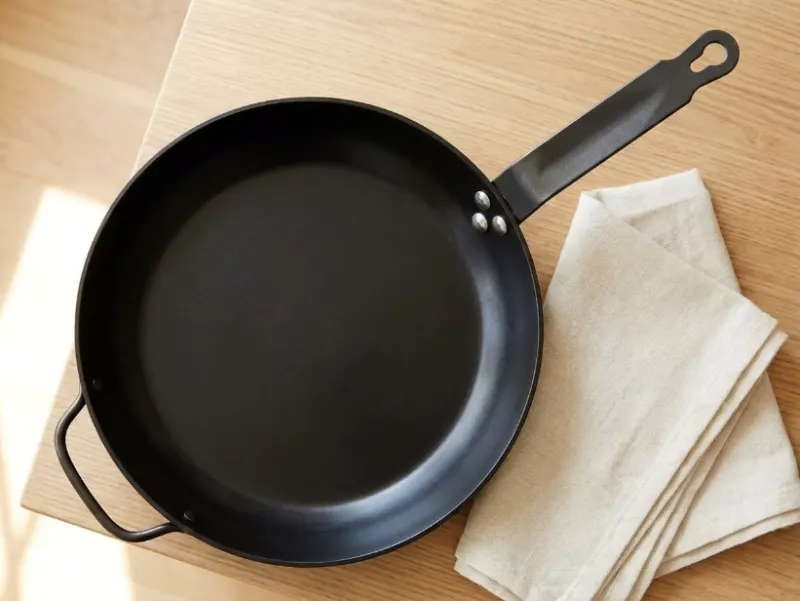
The Lodge 12-Inch Pre-Seasoned Carbon Steel Skillet weighs 4.15 lbs and handles any temperature your stovetop can produce.
A carbon steel pan bought today will still be working long after you would have replaced multiple nonstick pans. The question is whether the initial learning curve is worth the permanent upgrade.
Why Your Nonstick Pan Fails at High Heat#
The problem is not just that the coating degrades. The coating also fights the cooking result you want.
A proper sear needs sustained contact between food and a hot surface to drive the Maillard reaction and build fond, the concentrated browned residue that forms the base of pan sauces. Cooks consistently find that nonstick surfaces cannot develop fond because the coating is engineered to prevent exactly that adhesion. You are working against the pan's own design when you try to sear on it.
Then there is the durability question. Manufacturers cap PTFE cookware at medium heat. Each session above that ceiling subjects the coating-metal bond to thermal stress that accumulates over hundreds of cycles.
The damage compounds silently until the coating reaches the thresholds where it physically fails: fume release at 500°F, human symptoms at 662°F, full pyrolysis at 752°F. A pan that has been repeatedly stressed by high-heat searing reaches those failure points faster than one kept at medium.
Owners across Amazon and r/cookware consistently report the same pattern: pans used primarily for eggs and pancakes at medium heat last years longer than pans used frequently for searing. The manufacturer ceiling exists because every session above it accelerates the path toward material failure.
The result: your nonstick pan produces a worse sear today AND dies faster from delivering it. Both problems trace back to the same material choice.
What the Best Pan for High Heat Actually Needs#
If you sear more than once a week, switch to uncoated. Repeated sessions above the recommended medium range compound the damage. If you sear once a month or less and value easy cleanup above crust quality, keeping a nonstick pan for that purpose at medium heat is reasonable.
Among uncoated options, three materials meet every high-heat requirement. All are iron-based and work on any heat source including induction.
- Carbon steel preheats quickly, weighs significantly less than cast iron, and responds to burner adjustments quickly. Best for cooks who sear frequently and also want responsiveness for fish or vegetables.
- Cast iron stores significantly more heat. Surface temperature barely drops when cold food hits it. Best for thick steaks and chops where temperature stability through sustained contact matters most.
- Stainless steel has no temperature ceiling and requires zero maintenance. No seasoning to build or protect. Develops fond effectively for pan sauces. Best for cooks who want high-heat capability without any care routine.
The tradeoff between these three is thermal mass versus responsiveness, not quality. Higher thermal mass (cast iron) means less temperature drop when cold food lands. Lower thermal mass (carbon steel) means faster reaction to burner changes mid-cook.
Neither is universally better. Your cooking style picks the winner.
Carbon Steel: The Best Pan for High Heat Cooking for Most Stovetops#
Carbon steel is iron with less than 2% carbon, stamped from sheet metal into thin-walled pans. It develops a natural seasoning layer through use. Polymerized oil molecules bond to the iron surface over months of cooking, building a slick coating that improves with age rather than degrading. You can check which pans are genuinely PFAS-free using our cookware safety checker.

The Lodge 12-Inch Pre-Seasoned Carbon Steel Skillet ships ready to cook. Lodge pre-seasons their carbon steel at the factory, so you get basic food release from day one rather than spending the first week building a base coat. The pan weighs 4.15 lbs compared to 7.9 lbs for Lodge's own 12-inch cast iron. Community feedback across r/carbonsteel confirms the pre-seasoning holds up well under repeated high-heat use.
The real learning curve is the initial seasoning period. Food sticks until enough seasoning layers build up, and that frustration is what sends most people back to nonstick. The fix: cook fatty foods often during those first weeks (bacon, sausage, fried eggs in generous butter) and avoid anything acidic until the surface looks uniformly dark. With regular daily use, the surface progressively approaches genuine nonstick performance without any of the degradation risks.
For those weighing carbon steel against cast iron directly, carbon steel pan vs cast iron breaks down which material wins for each cooking task.
When Cast Iron Makes More Sense#
Cast iron carries more carbon (2-4%), making it brittle and requiring thick-wall casting. That thickness stores significantly more thermal energy than carbon steel at the same diameter.
For searing thick steaks or bone-in chops, that stored heat produces results carbon steel struggles to match. A cold ribeye drops surface temperature less on cast iron, which means faster crust formation and more consistent browning across the entire surface. The tradeoff: a 12-inch cast iron skillet weighs 7.9 lbs, takes longer to preheat evenly, and transitions to oven work better than any pan in your kitchen.
Weight is the practical limitation. On glass-top stoves, repeatedly setting down a heavy cast iron pan concentrates thermal stress on one section of the glass surface. For glass-top users who want cast iron's heat retention for occasional steaks, the best pan for searing steak walks through what matters most for the result.
Stainless Steel: High Heat Without Any Maintenance#
Stainless steel has no temperature ceiling for home cooking and no coating to damage. You can push it from stovetop to broiler without thinking about it.
Where stainless wins: fond development. Pour wine or stock into a hot stainless pan after searing chicken, scrape up the concentrated browned residue, reduce for two minutes. That is a pan sauce, and nonstick makes it structurally impossible. The surface that prevents sticking also prevents the food contact that builds fond.
The technique to prevent sticking on stainless: preheat on medium for 2-3 minutes, flick water drops onto the surface, and wait for them to form a single rolling ball (the Leidenfrost effect). Add oil at that moment. Add food. Do not touch it until it releases naturally. Posts across r/Cooking and r/AskCulinary consistently describe this technique becoming automatic within the first week of daily cooking.
For cooks who want zero maintenance alongside zero coating risk, stainless is the answer. For cooks who want to build a naturally nonstick surface over time with lighter weight, we point to the Lodge Pre-Seasoned Carbon Steel Skillet as the stronger starting point.
How to Sear Properly on Any Uncoated Pan#
The technique works the same across all three materials.
Preheat the empty pan for 2-4 minutes on medium-high. On electric stovetops, lean toward the longer end because the element cycles between on and off rather than delivering continuous heat.
Add a thin coat of neutral oil right before adding food. Adding oil too early lets it oxidize against hot metal and turn sticky.
Place food and leave it alone. The initial bond between protein and hot metal IS the sear forming. A complete Maillard crust separates from the pan naturally once it finishes developing.
Forcing food up before that point tears the incomplete crust off the meat and leaves it stuck to the pan. That "sticking problem" that drives people back to nonstick is actually the searing mechanism working correctly, interrupted too early.
After cooking, wash with hot water and a stiff brush. Dry immediately on a hot burner. For carbon steel and cast iron, wipe one barely-visible layer of oil over the surface before storage. The material selector quiz walks through this entire decision in about 30 seconds if you want a quick match to your cooking style.
That maintenance routine takes about a week to become automatic. We think the tradeoff is worth it for anyone who sears more than once a week. One pan, no replacement cycle, and a surface that gets better with the same high heat that kills coatings.