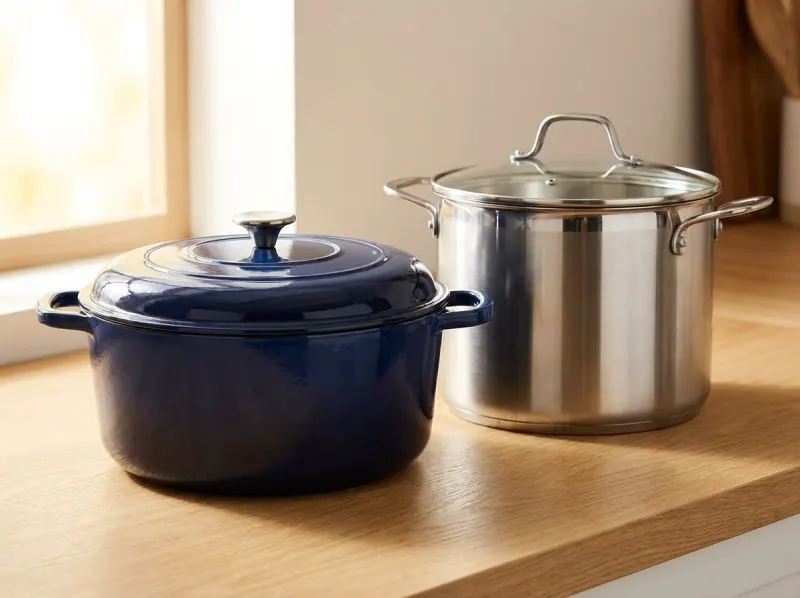
Every year, thousands of home cooks fry chicken in their lightest pan and wonder why the crust comes out pale and greasy instead of golden and crisp. They adjust the breading, try different recipes, fiddle with timing. The pan is the problem, and they never suspect it.
The best pan for frying chicken is an enameled cast iron chicken fryer at 9.2 lbs, like the Cuisinart 12-inch enameled chicken fryer. The weight is not a design flaw. It is the functional feature that separates crispy fried chicken from oily disappointment, because a heavy pan stores enough heat energy to keep oil at frying temperature even after cold chicken drops in.
We spent weeks digging through r/castiron threads, Lodge product documentation, and owner reviews to understand why the same recipe produces completely different results in different pans. The pattern we kept finding pointed to one variable that most guides never mention.
The question most people never ask: why would a nonstick coating help you fry chicken at all? Oil already prevents sticking. The coating is solving a problem that does not exist during frying, while the lightweight construction it demands creates the problem that does.
The Nonstick Trap: Designed for a Different Job#
Nonstick pans are engineered around one priority: protecting the PTFE coating. That coating releases fumes at temperatures as low as 500°F, so manufacturers build the pan thin and lightweight (check any pan against our PFAS safety checker for details) to heat and cool quickly, reducing thermal stress on the polymer layer. The result is a lightweight pan that handles eggs, fish, and crepes brilliantly.
Frying chicken demands the opposite. You need oil sustained at 350 to 375°F throughout the entire cook while cold bone-in chicken keeps pulling heat out of the oil. A lightweight nonstick pan stores so little thermal energy that oil temperature collapses the moment food goes in. You wait for recovery that never fully arrives, and the chicken absorbs oil instead of forming a sealed crust.
The mistake is understandable. People associate "nonstick" with "easy cooking" across the board. But the coating addresses food release, and oil already handles food release during frying.
Every design decision that protects the coating (thin walls, lightweight aluminum body, temperature ceiling) works directly against frying performance. No technique fix can make up for a pan built for a different job.
What Actually Matters: Weight as a Thermal Battery#
Lodge's own cooking guide states that "since cast iron holds heat, it's not necessary to use a heat setting above medium." That heat retention is the reason cast iron dominates frying. A 12-inch Lodge cast iron skillet weighs 7.9 lbs. The Cuisinart enameled chicken fryer weighs 9.2 lbs.
Pick up your current frying pan and compare. If the weight difference is dramatic, that is why your fried chicken is not crisping.
When you drop four cold bone-in thighs into oil, the pan must supply enough stored energy to push the oil temperature back up. A lightweight pan has no such reserve.
That difference in stored energy is the gap between frying and steaming.
Carbon Steel: The Middle Ground#
Carbon steel pans sit between nonstick and cast iron for weight and thermal mass. They work for frying if you already have one and keep the seasoning maintained.
For bone-in chicken specifically, cast iron's extra weight means more stored energy across a long cook. Carbon steel is a reasonable choice, not the optimal one.
Why We Picked the Cuisinart Enameled Chicken Fryer#
The criteria for frying chicken come down to four measurable things:
- Heavy cast iron construction (thermal mass)
- High walls for oil depth and splatter containment
- A fitted lid (finishing thick bone-in pieces with steam)
- An interior that handles acidic marinades without degrading
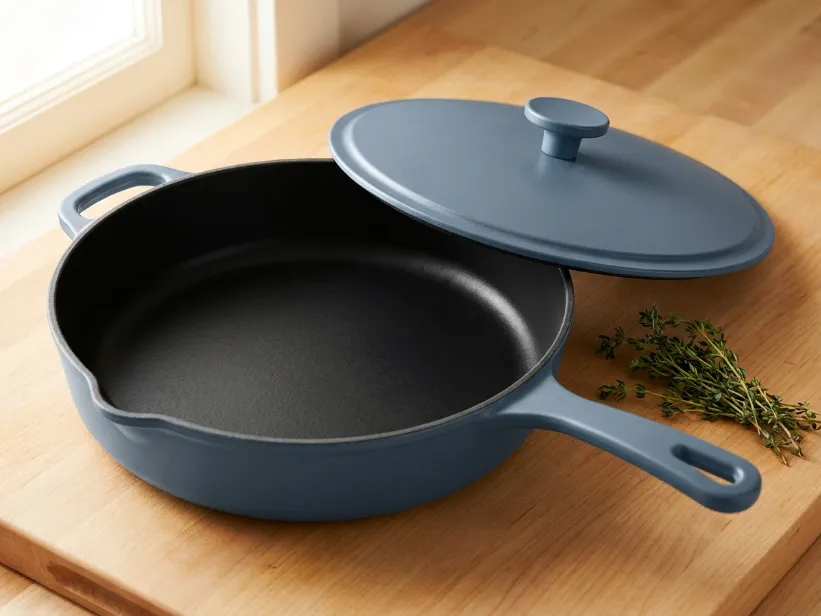
The Cuisinart CI45-30 enameled chicken fryer meets all four. At 9.2 lbs with a 4.25-quart capacity, 12-inch diameter, and included lid, it was purpose-built for exactly this job. The enameled surface means zero seasoning maintenance, which matters for any pan used to fry regularly. Acidic marinades and buttermilk brines will not damage enamel the way they strip seasoning off bare cast iron.
One honest limitation: Cuisinart has discontinued this model as of 2026, and remaining stock on Amazon is limited. If it sells out before you buy, any enameled cast iron pan of similar weight and dimensions fries chicken equally well. Lodge makes bare cast iron deep skillets (the L10CF3) that cost less and should deliver equivalent frying results given similar weight and construction. The enameled versus bare cast iron tradeoff comes down to whether you want maintenance-free convenience or lower cost.
Three Technique Fixes That Compound the Pan Advantage#
Switching to cast iron is the biggest single improvement. These three adjustments stack on top of it.
Preheat longer than feels necessary. Give the pan several minutes on medium before adding oil.
Use a clip-on thermometer rather than guessing. Patience here costs nothing and prevents the most common frying mistake: dropping food into oil that has not reached temperature.
Do not crowd. The pan fits 4 bone-in thighs, but fry 3 at a time for the crispiest results.
Work in batches. The second batch fries better because the pan and oil are thoroughly stabilized.
Let chicken rest at room temperature briefly before frying. This takes the refrigerator chill off the surface, reducing the initial temperature shock when it hits oil. This is well within safe food-handling limits per USDA guidance.
When Nonstick Still Earns Its Place#
We are not telling you to throw away your nonstick pan. For eggs, crepes, delicate fish fillets, and anything that needs to slide without resistance at moderate temperatures, nonstick remains the right tool. We covered when each material earns its place in a separate breakdown.
The problem is specifically about sustained high-heat frying where you need consistent oil temperature and a pan heavy enough to resist cold-food shock. Those requirements point to cast iron. If you want to fully submerge chicken for deep frying rather than pan-frying, we covered choosing a pan for that technique separately.

The Verdict#
If your fried chicken comes out pale, greasy, or unevenly cooked, the pan is almost certainly the problem. A heavy enameled cast iron fryer like the Cuisinart CI45-30 stores enough thermal energy to maintain oil temperature through the entire cook. The nonstick pan you have been using was engineered from the factory to protect its coating at the expense of the thermal mass you actually need. No recipe fix or oil choice can overcome that design problem.
Stop blaming technique. Switch the pan.