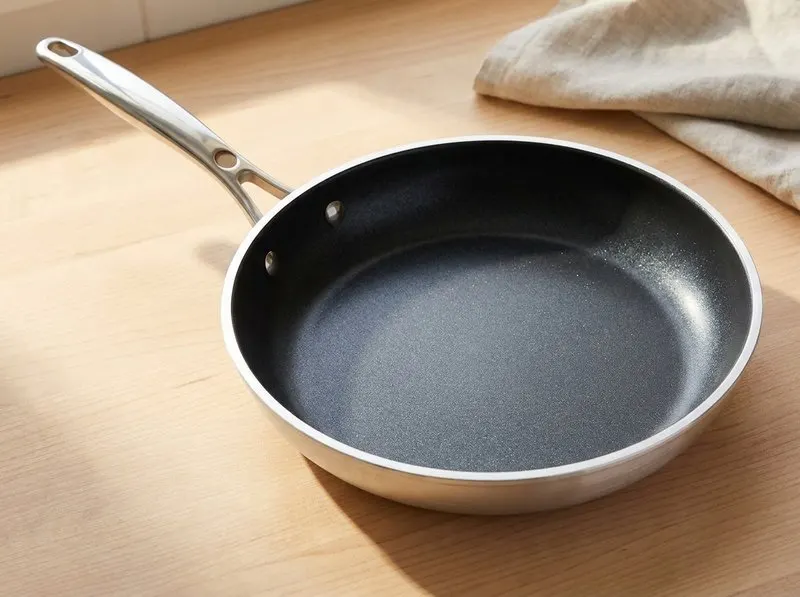
You just pulled a pound of sliced peppers out of your pan and they look pale, soft, slightly wet. The recipe said "saute until golden." Your pan said otherwise.
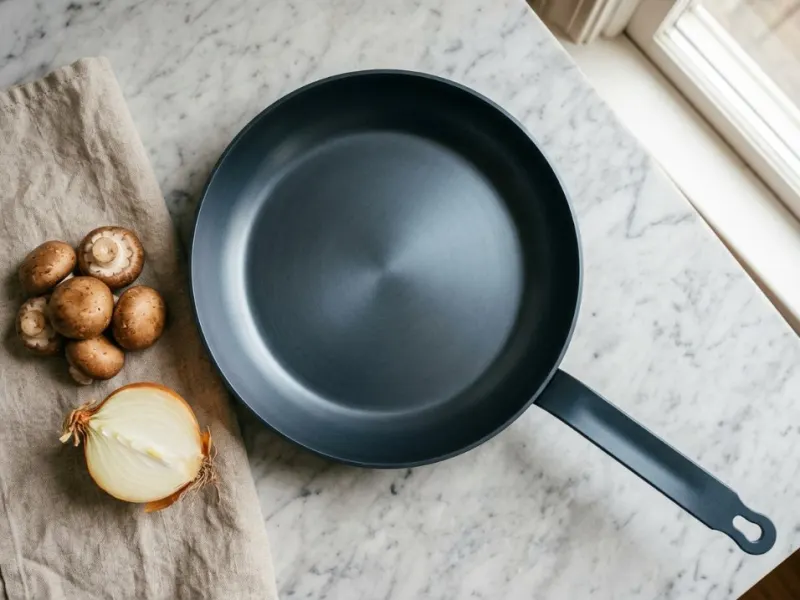
The best pan for cooking vegetables is a 12-inch carbon steel skillet. We recommend the de Buyer Blue 12.5-Inch. It delivers 9.13 inches of flat cooking surface, weighs 4.8 lbs, and the welded handle has no rivet crevices where vegetable residue collects.
Why that cooking-surface number matters, and why most pans produce soggy results even when the recipe is right, is what we dug into across owner reports, forum threads, and the manufacturer's own specs.
Here is what most guides get wrong: they jump straight to material recommendations. Carbon steel, cast iron, stainless. The advice sounds right. But the failure mode hiding behind "my vegetables came out limp" almost always traces back to a simpler variable.
The Number on the Box Is Lying to You#
When you buy a "12.5-inch pan," you get 9.13 inches of flat cooking surface. The rest is sloped wall. That gap between advertised size and actual usable area is the reason people crowd their pans without realizing it.
Think about what happens when you cook vegetables. Every piece needs direct contact with the flat surface to brown. Pieces stacked on top of each other sit in steam released by the vegetables below. The top layer never touches metal. It poaches.
The de Buyer Blue's dimensions from the manufacturer's own specifications tell the story across sizes:
- 11-inch rim delivers 8.3 inches of flat surface
- 12.5-inch rim delivers 9.13 inches of flat surface
That jump from 8.3 to 9.13 inches of flat surface is significant. For a pound of sliced mushrooms or two bell peppers worth of strips, the difference is between a single layer and a double-stacked mess.
If you are cooking vegetables for two or more people, the 12.5-inch is the starting point. Not because bigger is always better, but because 9.13 inches of flat is about what you need for a standard weeknight vegetable portion to sit in one layer.
Best Pan for Cooking Vegetables Starts With Size#
The complaint that shows up most consistently across r/Cooking and r/cookware threads about soggy vegetables is not about pan material. It is about volume.
Cold vegetables drop pan temperature on contact. When too many pieces hit the surface at once, the pan cannot recover heat fast enough to keep moisture evaporating. Water pools. Temperature collapses. You get steam instead of Maillard reaction browning.
A full-size nonstick pan with a single layer of vegetables at medium-high heat will outperform a crowded smaller carbon steel skillet every time. Size solves the physics. Material is the tiebreaker.
Why Carbon Steel Once Size Is Solved#
Once you have enough flat surface for a single layer, the pan material determines two things: how responsive the heat is and how long the pan lasts.
Carbon steel at 2mm gauge and 4.8 lbs (the Blue's specs) responds to burner adjustments faster than cast iron at 7.9 lbs. When garlic starts to darken too quickly or greens wilt faster than expected, dropping the heat on carbon steel produces an immediate result. Cast iron's thermal mass holds temperature stubbornly for minutes after you reduce the flame.
That responsiveness matters for vegetables specifically because most vegetable cooking involves at least one mid-cook adjustment. High heat for the initial sear, then a drop to finish without burning the fond.
Carbon steel also outlasts any nonstick coating. The pan improves with use as seasoning builds through regular cooking. There is no replacement cycle, no degrading surface, no timeline where performance declines. For daily vegetable cooking, that permanence changes the economics entirely.
The de Buyer Blue 12.5-Inch Specifically#
We recommend the de Buyer Blue after comparing specs and owner feedback across carbon steel options in this size range. Three details stood out for vegetable-heavy daily cooking.
The welded handle eliminates rivet crevices entirely. Riveted pans (common in this category) create small gaps where garlic, onion, and mushroom residue collects during cooking. Amazon owners consistently mention scrubbing around rivets after caramelized-onion sessions. A smooth welded joint means a flat wipe cleans the interior.
The bluing finish is a factory-applied heat treatment that gives the steel an oxide layer before you season it. De Buyer describes it as a process that makes the metal more resistant to oxidation. For a pan dedicated to vegetable cooking, where moisture exposure is constant from day one, starting with an oxidation-resistant surface rather than bare raw steel is a practical advantage during the initial weeks of building seasoning.
The pan is also oven-safe to 500 degrees, which means you can start a pan of root vegetables on the stovetop for initial color and transfer directly to a hot oven for interior cooking. No pan swap, no dish transfer. If you want to verify oven limits across brands, the oven-safe temperature lookup covers the common ranges. The de Buyer Blue handles both without restriction.

Two Technique Points That Protect the Investment#
The pan sets the ceiling. Two adjustments from experienced vegetable cooks close the gap between a good pan and good results.
Preheat the empty pan before adding oil. Give the oil a moment to shimmer before vegetables go in. Cold pan plus cold oil plus cold vegetables means everything heats simultaneously while moisture releases unchecked. The pan cannot establish the heat differential that produces browning.
Give vegetables uninterrupted contact time. The crust that builds during the first stretch of stillness produces surface color and fond. Stirring too early releases half-formed browning before it sets. For constant-motion cooking, a wok is the better geometry.
When This Pan Is Not the Right Answer#
If your vegetable cooking is primarily wilting spinach, warming frozen corn, or steaming-then-finishing tender greens, you do not need carbon steel. A nonstick pan at any size handles gentle cooking without the seasoning commitment. Carbon steel earns its place when the goal is color, fond, and caramelization at medium-high sustained heat.
For stovetop compatibility questions beyond what we covered here, the material selector quiz asks six questions about your habits and gives a direct answer.
The de Buyer Blue 12.5-inch sits at 9.13 inches of flat cooking surface, 4.8 lbs, welded handle, oven-safe to 500 degrees. For most home cooks doing weeknight vegetables for two or more, it removes the two failure modes that produce soggy results: not enough flat surface, and a pan that cannot keep up with temperature demands. That is why we recommend it.