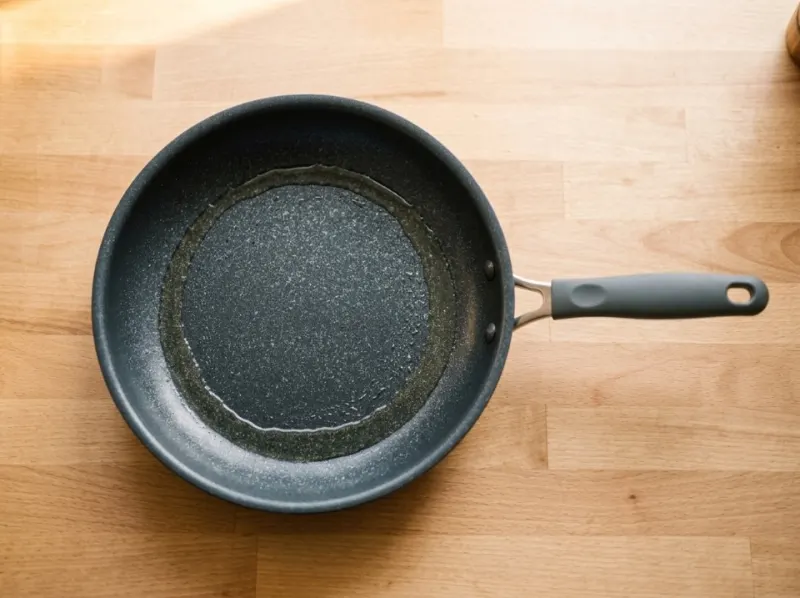
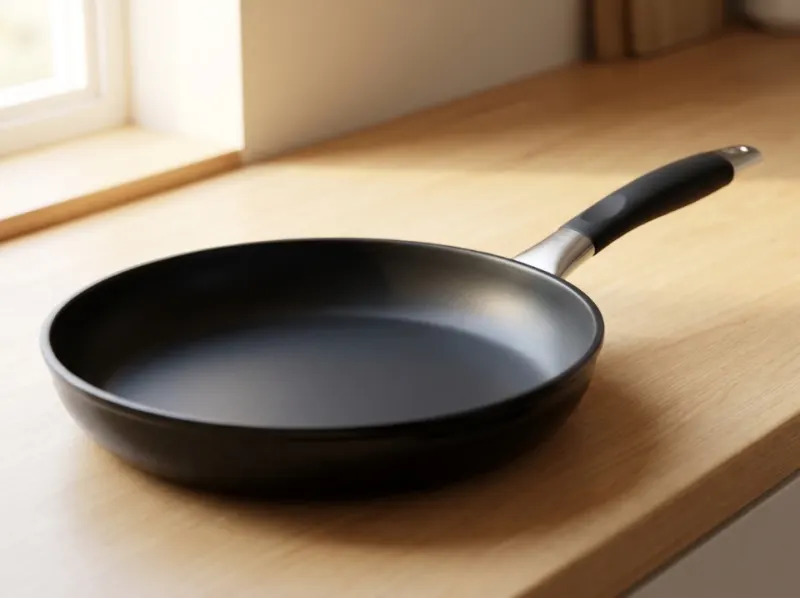
You already own the right pan for omelettes. It is probably sitting in your cabinet right now, ignored because someone convinced you that better omelettes require a better pan.
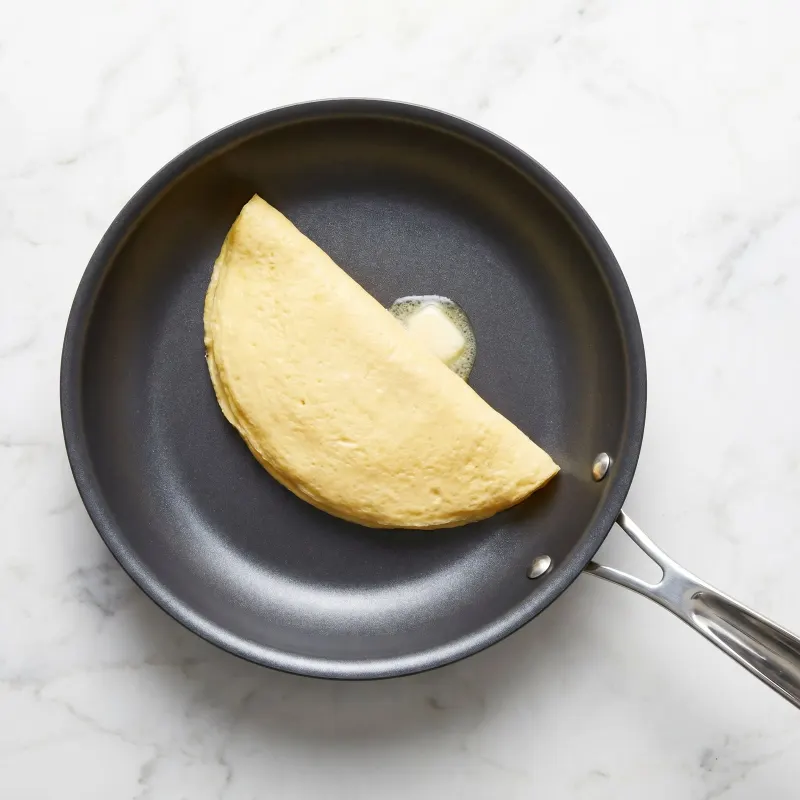
The best omelette pan is any 8-inch nonstick fry pan with sloped sides and a base thick enough that you cannot flex it by pressing the center.
Brand and coating technology matter far less than those three physical characteristics. If you want a specific pick, we point to the Scanpan Classic 8-Inch Fry Pan for its even heating, rivetless interior, and lifetime warranty.
Below, we explain why almost any 8-inch nonstick with a solid base produces the same quality omelette.
The question nobody explains is why size makes the difference. That is what this article is actually about.
Why 8 Inches Produces Better Omelettes Than 10 or 12#
The physics here are simple enough that once you understand them, you will never use a large pan for omelettes again. Three beaten eggs are a fixed volume of liquid. Pour that liquid into a 12-inch pan and it spreads across a wide surface into a paper-thin sheet that overcooks in seconds and tears the instant you try to fold it.
Pour the same three eggs into an 8-inch pan and they form a compact layer with enough thickness to hold together. You get time to work, a fold that does not split, and an inside that stays just barely set.

This is not theory. Cooking practitioners across r/Cooking and dedicated cookware communities recommend 8-inch for 2-3 egg omelettes specifically because the layer thickness makes folding reliable. One practitioner put it directly: an 8-inch pan for a 3-egg omelette, and you scale up only when the egg count demands it.
The size controls the outcome more than your technique or your budget.
What Actually Determines Omelette Quality in a Pan#
Three features separate a pan that makes omelettes easy from one that makes them frustrating. None of them are brand name, coating technology, or price tier.
Nonstick surface in good condition. Egg whites grab bare metal on contact. Stainless steel and unseasoned cast iron are workable for omelettes but demand generous butter, proper preheat, and more confidence than most weekday mornings allow.
A functional nonstick surface eliminates the sticking problem entirely. You focus on timing and folding rather than fighting the pan. Carbon steel can reach a similar release after months of seasoning, but few people commit to that. Nonstick is the practical default for eggs, and we see it confirmed in community discussions about egg sticking.
Gentle slope from cooking surface to rim. That curve lets your spatula slide under the omelette at an angle rather than hitting a vertical wall. It also means you can tilt the pan and slide the finished omelette onto a plate in one smooth motion. Straight-sided saute pans trap the edges and make plating awkward, which is exactly why frying pans and saute pans exist as separate shapes.
Even heating across the base. Cheap thin pans develop hot spots directly over the heating element. The center of your eggs overcooks while the outer ring stays liquid. A heavier base with more thermal mass spreads heat outward and delivers a uniformly set omelette without constant swirling.
The flex test tells you everything you need to know: press the center of the pan with your thumb. If the base flexes, it is too thin and will hot-spot on your stove.
The Dedicated Egg Pan Strategy#
The most impactful thing you can do for omelette quality has nothing to do with which pan you buy. It is reserving whatever pan you choose exclusively for eggs. The material selector quiz can help narrow the field if you are unsure where to start.
A nonstick pan used for everything (searing, stir-frying, deglazing) takes punishment that accelerates coating degradation. Amazon owner reports on mid-range PTFE pans like T-fal and Tramontina show the contrast clearly.
Careful users on Amazon describe getting 4 to 5 years from their nonstick before replacement becomes necessary. Owners who describe using the same pan for high-heat searing report coating failure in as little as about a year.
A dedicated egg pan by definition lives in the careful-use category. It never sees high heat, never touches metal utensils, never goes through the dishwasher.
Under those conditions, even a budget pan outlasts a premium pan that doubles as your everyday skillet.
One safety note worth stating clearly: PTFE nonstick coatings begin releasing fumes at 500°F, though human symptoms (polymer fume fever) do not start until 662°F, with pyrolysis beginning at 752°F. An empty pan on high heat can reach these temperatures quickly. Our cookware safety checker lists which lines are bare metal and which carry a coating, with the source quoted for each.
A dedicated egg pan on medium heat with butter or oil added early never comes close. The hazard is real but completely avoidable with normal cooking practice.
Why We Recommend the Scanpan Classic 8-Inch#
The Scanpan Classic 8-Inch Fry Pan earns the specific recommendation because it executes on all three requirements at a level that justifies its premium over budget alternatives.
The recycled cast aluminum body at 1.85 lbs distributes heat quickly and evenly with no hot spots, confirmed on the manufacturer's own spec sheet. It passes the flex test with room to spare.
The STRATANIUM nonstick coating is rated metal-utensil safe.
The rivetless interior means zero crevices where egg residue can hide, which makes cleanup genuinely effortless.
Scanpan manufactures these in Denmark and backs them with a lifetime warranty. The pan is oven-safe to 500°F for stovetop-to-oven techniques if you ever need that flexibility for a frittata.
The honest counterpoint: you do not need to spend at the premium tier for excellent omelettes. Any 8-inch nonstick fry pan with a base that does not flex will produce the same results in its first year or two.
The Scanpan's advantage is the heavier build quality (no flex, even heating from day one), the rivetless interior for effortless cleanup, and a lifetime warranty backing the body. If those matter less to you than keeping replacement costs low, a budget pan replaced every couple of years is a perfectly rational strategy.
Getting Clean Folds Every Time#
Your pan handles the release. Your technique handles the fold. Here is what we have found works consistently across community advice and practitioner demonstrations.
Preheat on medium for about a minute. Add a teaspoon of butter and wait for the foam to settle, then drop to medium-low before pouring the eggs. High heat sets the bottom too fast and forces you to overcook the outside waiting for the inside to finish.
Fold while the surface still looks slightly wet and glossy. The residual heat in the pan continues cooking the eggs after you fold. Waiting until the top looks fully set guarantees a rubbery interior by the time you sit down.
Clean the pan immediately with warm water and a soft sponge. Dried egg grabs the surface and eventually requires scrubbing force that shortens coating life across hundreds of washes. A dedicated egg pan that gets wiped right after breakfast is a dedicated egg pan that lasts years.