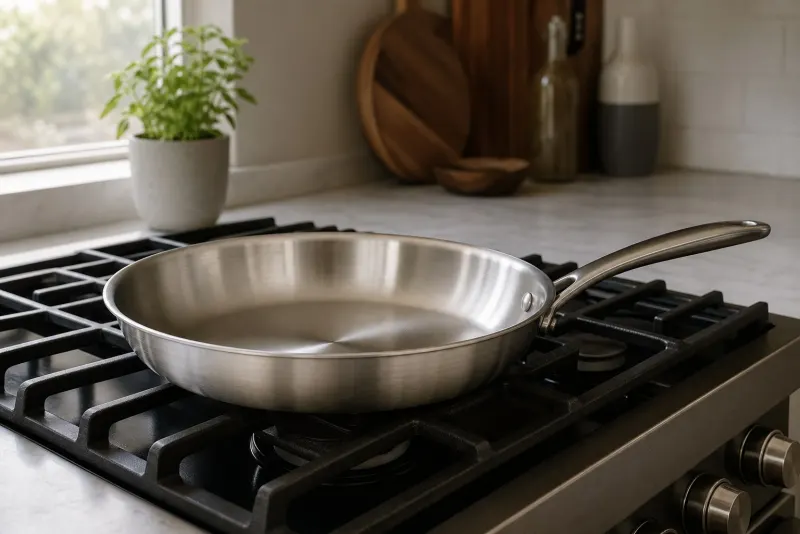
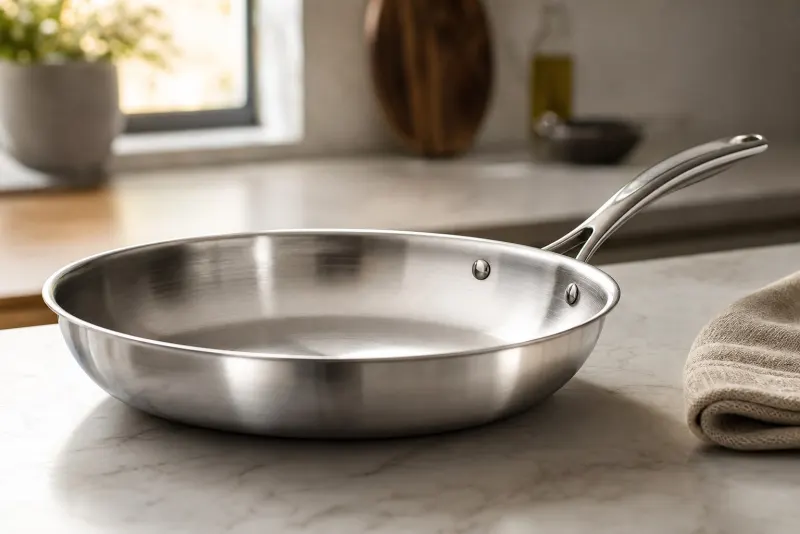
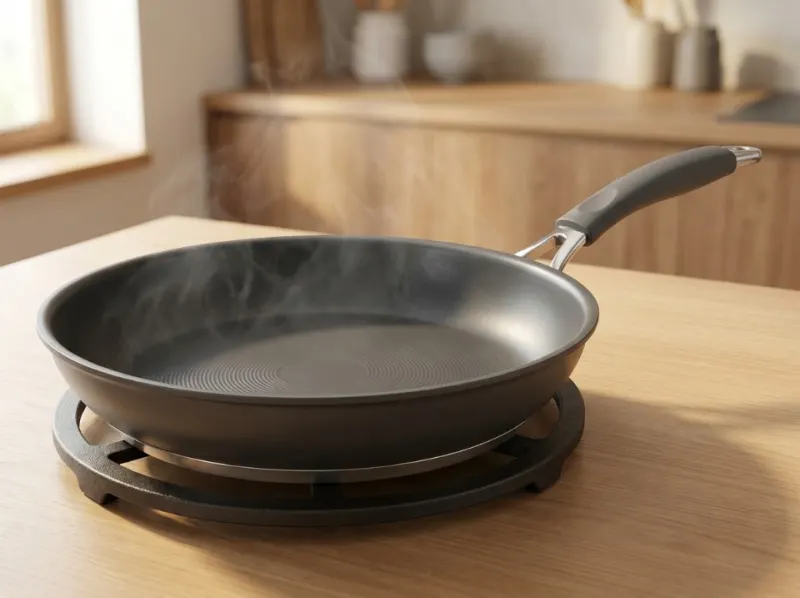
You buy the nonstick pan with all the five-star reviews. Eggs slide off it for a few blissful weeks. Then, one ordinary Tuesday, they don't.
That moment is not a defect.
The best non-stick pan that actually lasts is the T-fal Experience Nonstick Fry Pan. It fits the typical 2 to 3 year non-stick service window, costs far less than premium PTFE pans, and uses a Thermo-Spot indicator that helps prevent the overheating mistake that kills coatings early.
Our nonstick cookware buying guide covers that same durability math across the whole category, not just this one pick.
Even that pan will eventually fail, because every non-stick coating is built to fail on a schedule.
The real question isn't which pan lasts forever. None of them do. It's which one buys the most cooking time for the least money, and what's quietly cutting that timeline short in most kitchens.
We dug through owner reports, cookware forums, and the coating science behind why non-stick fails to sort out which parts of that story matter, and which are just marketing noise.
The Uncomfortable Truth About Non-Stick#
Here's what the cookware industry would rather buyers not think about too hard. Non-stick coatings are consumable. Every non-stick pan has a lifespan, and that lifespan is measured in years, not decades. This is fundamentally different from cast iron or stainless steel, which get bought once and kept for life.
The coating breaks down from heat, from utensils scratching the surface, from thermal shock, from dishwashers, and from plain regular use. Some coatings last longer than others, but none of them are permanent. Thin or poorly bonded coatings often show coating peeling off early because the PTFE layer cannot withstand normal thermal stress. If a brand implies its non-stick will last a lifetime, it's either lying or has redefined "lifetime" in the fine print.
Once you accept that, the buying decision gets simpler. The goal isn't the pan that lasts forever. It's the best ratio of performance to price, with a plan for replacing it without guilt. And if you're trying to figure out whether your current pan has crossed from worn to done, that's covered in whether a scratched nonstick pan is still safe to use.
The Pick: T-fal Experience Nonstick#
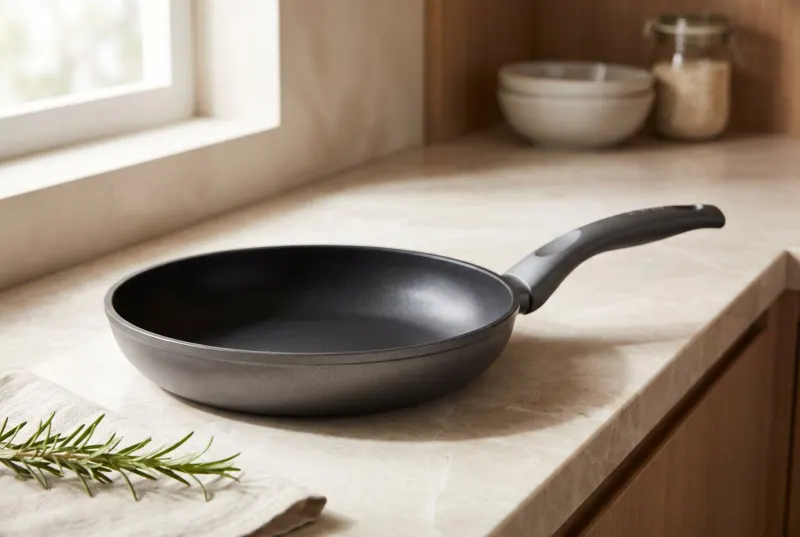
The T-fal Experience Nonstick Fry Pan 12.5-Inch sits at the budget end of the market, and the coating holds up longer than the price tag suggests it should. The heat distribution is even enough for home cooking, and it has reasonable weight without being flimsy.
The premium-price comparison isn't a slogan. Published lifespan reporting puts the average non-stick pan at 2 to 3 years of good release, while reinforced coatings sit inside the broader 1 to 5 year non-stick range instead of rewriting it. That means a premium PTFE pan needs to last several times longer to justify costing several times more. The published data does not support that bet.
Will the T-fal land at the far end of the full one-to-five-year non-stick range? Maybe if you treat it gently, but we would not buy it on that hope. At this price point, it doesn't need to. If you cook a lot of fish specifically, the separate guide on the best pan for cooking fish covers why a quality nonstick surface matters even more for delicate proteins.
The Thermo-Spot indicator in the center earns its keep. It changes color once the pan is fully preheated, taking the guesswork out of timing. Overheating is the single biggest coating killer, and this feature helps stop that mistake before it happens. The mechanism is thermal cycling: the PTFE coating and aluminum body expand and contract at different rates, creating microscopic stress fractures over repeated heating and cooling.
The downsides are real but minor. The handle gets warm on longer cooks, not burning hot, but warm enough to notice. And it's only oven-safe to 400°F. If your routine involves starting something on the stove and finishing it in the oven at higher temps, this isn't the pan for that.
The Step-Up Option#

For something that feels more substantial, the Tramontina Professional 12-Inch Fry Pan is excellent. It sits in the same budget tier and is built from heavy-gauge aluminum with a genuinely restaurant-grade feel.
Tramontina doesn't get the name recognition of brands like All-Clad or Calphalon, but its Professional line is branded and sold as a "Restaurant Fry Pan," and it's NSF-certified for commercial kitchens, meeting durability standards most home cookware doesn't bother with.
Why isn't it the top pick? Availability. Tramontina's Amazon stock comes and goes, some weeks in at its usual budget-tier price, other weeks out entirely. The T-fal is consistently available and consistently priced, and for a "just tell me what to buy" recommendation, reliability of purchase matters. If you want a direct head-to-head between T-fal and the closest Cuisinart equivalent, including construction, we put the two brands side by side in T-fal vs Cuisinart.
What About Ceramic Non-Stick?#
Ceramic coated pans like GreenPan and Caraway use a mineral-based sol-gel coating instead of PTFE, and market that difference as the healthier choice, pointing to PFOA as the reason to avoid PTFE. On that specific point, modern PTFE cookware has been free of PFOA since 2015, when a voluntary EPA stewardship program achieved industry-wide phaseout, and the FDA classifies PTFE itself as an approved food-contact material.
We're not in a position to referee every broader PFAS health question here. What we can speak to with confidence is durability, and on that measure the gap is stark. Ceramic non-stick coatings degrade faster than PTFE, significantly faster.
Published lifespan reporting and cookware community threads point in the same direction. Brand new, ceramic is incredible: eggs practically levitate. But ceramic-coated pans average about 2 years of effective release, and some degrade in as little as 1 to 3 years. PTFE generally lasts at least 3 years with proper care, which is why ceramic is a poor value pick when durability is the main question.
If avoiding fluoropolymers specifically still matters to you for personal or environmental reasons, ceramic is a legitimate choice on those grounds. Just know the trade is longevity for it. The pan gets replaced more often.
The "Buy Once" Alternative#

If the whole disposable non-stick cycle is frustrating, there's an option most cookware articles skip. Carbon steel. A carbon steel pan, once properly seasoned, develops a natural non-stick surface that improves with use instead of degrading.
The de Buyer Mineral B Carbon Steel Fry Pan 11-Inch is priced in the mid-range and will outlast every non-stick pan in existence. It requires seasoning and maintenance, similar to cast iron but lighter and more responsive to heat changes. After the seasoning builds, eggs slide off it almost as easily as they do on a fresh non-stick pan, and the Mineral B line carries 15,000-plus Amazon reviews across its size variants, a loyal following that's stuck around for a reason.
The catch is a learning curve. Food sticks until the seasoning builds up. Drying after washing, occasional oiling, and avoiding acidic foods until the seasoning is established are all part of the deal. It's not a drop-in replacement for non-stick if you need day-one performance.
But if you're tired of replacing the same pan every few years, carbon steel is the exit ramp. The full comparison lives in carbon steel vs nonstick.
How to Make Any Non-Stick Pan Last Longer#
Regardless of which pan you buy, four things make the biggest difference in how long the coating survives.
Never use high heat. Medium is the maximum for non-stick. High heat breaks down the coating faster than anything else. If food isn't cooking fast enough on medium, give the pan more time to preheat instead of turning up the burner.
Skip metal utensils. Use silicone, wood, or nylon. One careless scrape with a metal spatula can score the coating and start the deterioration process.
Hand wash only. The dishwasher is brutal on non-stick coatings. A soft sponge and mild soap takes thirty seconds and extends coating life significantly.
Don't stack pans bare. If they stack in a cabinet, put a towel or felt liner between them. The bottom of one pan grinding against the cooking surface of another will scratch the coating over time.
What to Actually Buy#
For the best value with the least hassle, get the T-fal Experience Nonstick 12.5-Inch. Use it for eggs, fish, pancakes, and anything else that tends to stick. If eggs specifically give you trouble even on a fresh pan, the egg sticking problem usually traces back to heat and timing rather than a dead coating.
Keep the heat at medium, hand wash it, and expect the typical 2 to 3 year non-stick service life before the coating starts to go. A premium PTFE pan would need to multiply that service life to justify its price, and published lifespan reporting only says reinforced coatings hold up longest inside the same broad non-stick range. If pancakes are the main goal, our guide to the best pan for pancakes covers why pan weight and wall height matter more than coating type for even, edge-to-edge browning.
If you're ready to break the replacement cycle entirely, carbon steel is the answer: more effort upfront, but it pays off long term. For the exact math, the cookware cost calculator breaks it down by material and usage frequency.
The one thing not worth doing is spending a premium price on a non-stick pan for coating life alone. Premium bodies can feel better, and reinforced coatings tend to sit toward the better end of the category, but the coating is still consumable. The full breakdown is in whether expensive non-stick pans are worth it.
Save the premium budget for cookware that actually rewards it: stainless steel, cast iron, and carbon steel all do. For non-stick, buy smart, treat it well, and replace without guilt.
If ceramic is on your shortlist as a "safer" alternative, the ceramic vs teflon comparison covers the trade-offs. And if you're building a kitchen from scratch, the first apartment cookware guide covers which pieces earn their shelf space. Still torn on which material fits your kitchen? Answer the six questions in the material selector quiz and get a straight recommendation.