Every griddle listing we've read says it works on gas, electric, glass, and induction. Put the same griddle on two different stoves in the same kitchen. You can get two completely different results.
A griddle top for gas stove works exactly the way the listing promises. A continuous flame ring heats the full surface, so spanning two burners really does give you one large, evenly cooked area. That same griddle on induction or glass-top radiant heats through separate, fixed zones instead. A griddle sized to bridge two of those zones gets two hot ends and a gap in the middle, not double heating.
Nobody selling griddles mentions that gap. We went looking for why it happens, and which griddle actually avoids it.
"Works on Every Stove" Is a Checkbox, Not a Compatibility Test#
Griddle listings check every box: gas, electric, glass, induction, oven, campfire. That's technically true for most cast iron and carbon steel griddles. Both materials conduct heat, and both respond to a magnet.
What the checkbox skips is how each stove actually delivers that heat.
A gas burner produces a ring of open flame. That flame reaches past its own lit diameter through convection and radiant heat. A griddle spanning two gas burners sits over one continuous heat source, even though it's technically two separate flames.
Induction and glass-top radiant don't work that way. Each cooking zone is a fixed, separate component: a coil for induction, a resistive element for radiant.
KitchenAid's and Whirlpool's own induction support pages both say the same thing. Don't use a pot that exceeds the perimeter of the cooking zone in use. KitchenAid adds that oversized pans "may decrease performance."
Neither manufacturer describes a way for one zone to help the one next to it. A griddle bridging two zones gets whatever each zone delivers to the section sitting over it, and nothing in the gap between them.
Gas Stoves: Size and Material Come Down to Preference#

If your stove is gas, the two-burner sizing question is a non-issue. Pick the size that matches how much you cook at once, and pick the material based on what you want from the pan.
Cast iron and carbon steel hold heat longest for searing multiple batches back to back. A lighter aluminum griddle heats up faster and cools down just as fast, which suits cooking for one or two people.
One tradeoff still matters on gas. A large two-burner cast iron griddle needs a slow, patient, low-heat preheat before the surface evens out. That's the same behavior we found researching the best cast iron griddle shape-to-burner match.
Rush that preheat and you get scorched edges with a still-cool center. The flame reaches the whole surface fine. Cast iron itself is just slow to spread heat internally.
Glass-Top Radiant: Fit the Element, Not the Photo#
Glass-top stoves add a constraint gas never has. The surface itself can scratch, and in rare cases involving direct impact, it can crack.
Our research into glass-top handling comes down to one rule that beats material choice every time: never slide cookware across the surface. Always lift it into place with two hands.
For griddle sizing, treat each radiant element like an induction zone. A griddle spanning two elements heats the sections sitting over each one and lags in between. A flat-bottomed pan conducts heat from direct contact with the hot glass below it, and there's no heat source under the gap.
Whirlpool's own glass-ceramic maintenance guidance says flat-bottomed cookware gives "the best heat conduction and energy efficiency," while a base that's "rounded, warped, ribbed or dented" causes uneven heating. That's a claim about shape, not material, and it applies whether the griddle sits over one element or bridges two.
Want the lightest option for handling safety? An aluminum griddle with a smooth anodized or ceramic base cuts the most weight versus cast iron.
Want to stick with cast iron or carbon steel for heat retention instead? A single-zone round griddle skips the bridging problem entirely. It sits fully within one element's footprint, so the whole surface gets the same heat. For a quick personalized recommendation, try the material selector quiz.
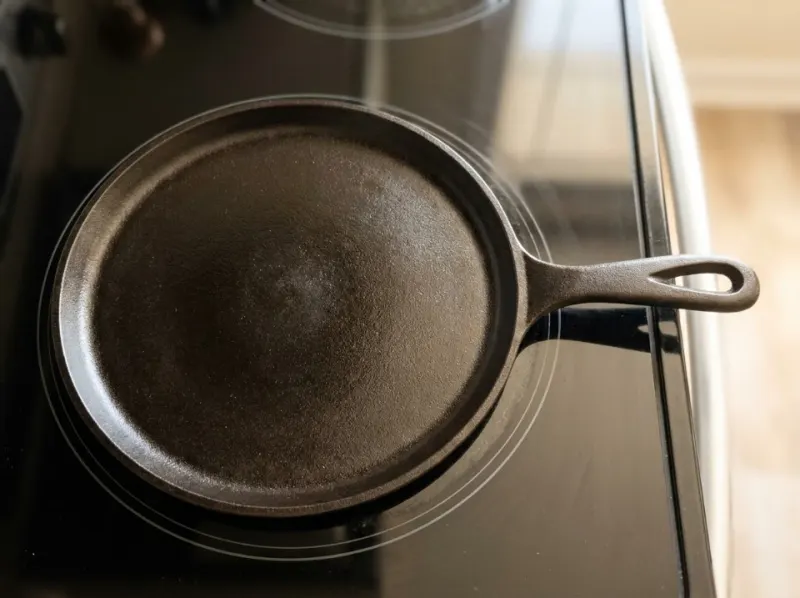
A round griddle built for that exact footprint, like Lodge's 10.5-inch round griddle at 4.38 lbs, weighs about a third of a full 13.5-lb two-burner cast iron piece. That matters directly for glass-top handling: less mass to lift means less risk if your grip slips.
That recommendation comes with one real tradeoff. Like the rest of Lodge's standard line, the L9OG3 has a rough, sand-cast surface under its factory pre-seasoning, not the machined-smooth finish that pricier single-zone options like Stargazer or a vintage Griswold use. Food-science YouTuber Adam Ragusea ran a side-by-side egg test comparing a rough new modern pan against a machined-smooth one and found the rough surface released food noticeably worse until repeated seasoning built up enough to fill the casting pits. On a flat griddle with no raised sides to help you work food loose, that early stickiness is more noticeable than it would be on a skillet.
Induction: Ferromagnetic, and Sized to One Zone#

Induction adds a requirement gas and radiant don't have. The griddle's base has to be ferromagnetic, meaning a magnet grips it firmly across the whole surface, not just at the rim.
Cast iron, carbon steel, and enameled steel all pass. Bare aluminum, copper, and most glass or ceramic bases don't, and won't heat at all unless the cooktop detects a bonded magnetic disc in the base.
Even once the material passes the magnet test, the zone-size rule from earlier still applies, and it applies at full strength. Induction has no fallback heat path the way gas does.
Whirlpool's induction troubleshooting page echoes KitchenAid almost word for word: don't use a pot that exceeds the cooking zone's perimeter, and use "the cooking zone that best corresponds to the minimum diameter" of the pot's base.
Both manufacturers flag a sneakier second issue too. A griddle's printed base diameter doesn't always match its actual ferromagnetic footprint. A griddle that looks correctly sized on the box can still underperform if the magnetic layer underneath is smaller than the stamped number suggests.
Drag a magnet from the rim to the center of any griddle you're considering, not just the edge. A firm, even grip the whole way across means the whole base is doing the work.
A grip that goes soft toward the middle means only part of the base is ferromagnetic. That produces the same uneven result as an oversized griddle, for a different reason.
The Two-Burner Griddle Some Owners Already Regret#
One account on Cooking Stack Exchange answers a reader asking whether a carbon steel griddle spanning two electric burners heats evenly. It reports that the griddle heated "super unevenly," attributing this to carbon steel's high heat capacity and low heat conductivity, the same properties that make cast iron slow to even out on gas.
The mechanism itself is what KitchenAid and Whirlpool document directly, not the Stack Exchange account: a flat piece of ferrous metal bridging two separate, fixed heat sources doesn't average the zones together. It runs two hot ends with a slower middle. That single account is one real-world illustration of the pattern the manufacturers describe, not the basis for the claim on its own.
That's the exact gap the two-burner marketing claim never mentions. A continuous gas flame ring makes the two-burner claim true. The manufacturers' own zone-perimeter guidance is what makes it false on induction and glass-top radiant.
The Verdict#
Buy for your stove type first, not the biggest griddle in the listing photos. On gas, a two-burner griddle works as advertised, and size just comes down to how much you cook at once. On glass-top and induction, size the griddle to one element or zone, unless you've confirmed your specific cooktop bridges two zones for exactly this use case.
Our safe default for anyone who isn't gas-only: a single-zone-sized griddle like the Lodge 10.5-inch round griddle. It's ferromagnetic for induction, sized to sit fully within one radiant element, and light enough to lift confidently onto glass.
Gas-only and want the bigger two-burner surface for family breakfasts? Our full best cast iron griddle review covers the reversible Lodge Pro-Grid and the preheat patience it demands.
Before you buy anything for induction, run the magnet test yourself. Our induction compatibility guide walks through exactly how. It takes less time than reading one more listing that promises a griddle "works on every stove." Our induction compatibility checker tells you whether a pan has a truly magnetic base or just a thin disc.