Most budget cookware guides rank by sticker price. That metric ignores the one variable that changes everything: how many years the set actually lasts before you replace it.
The Cuisinart MultiClad Pro 12-Piece Set is our pick for the best cookware set in this budget range. It uses fully clad tri-ply construction with an aluminum core running through the sidewalls, oven safe to 500°F, induction compatible on every piece, and built from materials that owners report lasting well over a decade of daily use without performance decline.
The catch is a short learning curve. Most buyers who return stainless steel sets quit before mastering the one technique that makes everything work.
Why the Best Cookware Set Under 300 Is Stainless Steel#
The question most buying guides skip is not which set has the best features. When we dug into owner threads on r/cookware and long-term Amazon reviews, the question that actually decided our recommendation was: what does a set cost per year of actual use? When you divide purchase price by years of service, the math inverts everything listicles tell you about budget cookware.
Owners on Amazon and r/cookware commonly report nonstick coatings failing around the 2 to 3 year mark with normal use. Eggs start sticking, the surface roughens, food release declines. A mid-range nonstick set replaced every couple of years costs several times more per year than a tri-ply stainless steel set you never replace. Reports across r/BuyItForLife consistently show fully-clad stainless sets still performing after well over a decade of daily home cooking.
That durability gap is the pattern we kept seeing in our research. It explains why budget cookware listicles consistently get the ranking wrong. They organize by material variety (show one nonstick, one ceramic, one stainless, one cast iron) because the format demands visual diversity. A ranking organized by cost-per-year would put stainless first every time.
The Rim Test That Decides Everything#
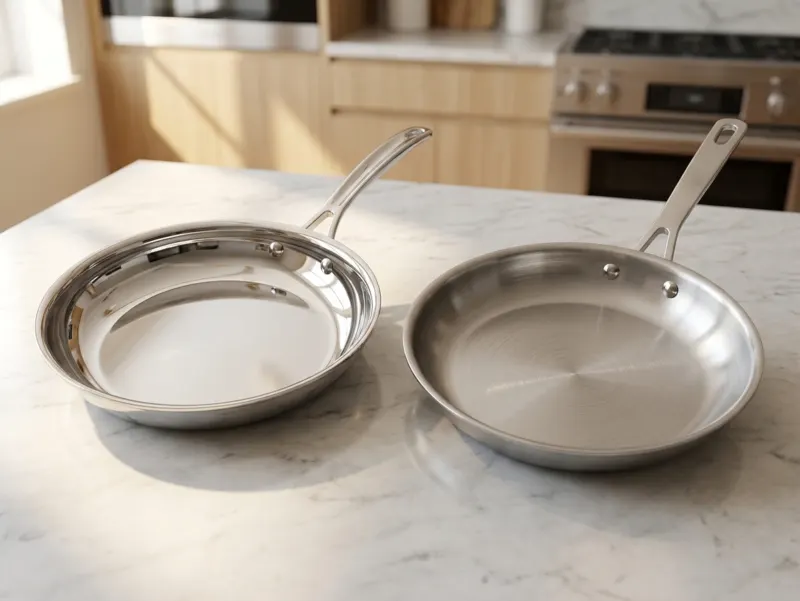
Before buying any stainless set, hold a pan sideways and look at the cut edge of the rim. Fully clad tri-ply shows a visible three-layer sandwich: steel, aluminum, steel, running edge to edge. Disc-bottom pans show a single-layer wall with a thick puck attached only to the base.
This matters because aluminum conducts heat approximately 16 times faster than stainless steel (237 versus 14.9 W/mK per NIST reference data). In a fully clad pan, that aluminum core carries heat up through the sidewalls so the entire cooking surface heats evenly. In a disc-bottom pan, the sidewalls are bare single-layer stainless with almost no thermal conductivity. Sauces pooled against the edges cook at a different rate than liquid at the center.
The Cuisinart MultiClad Pro passes this rim test on every piece in the set. Cuisinart markets this as "Heat Surround technology," which is their branding for fully clad construction maintaining even heat distribution along the base and sidewalls. Many budget sets at the same price point use disc-bottom construction and bury this detail in the fine print.
What the 12-Piece Configuration Covers#
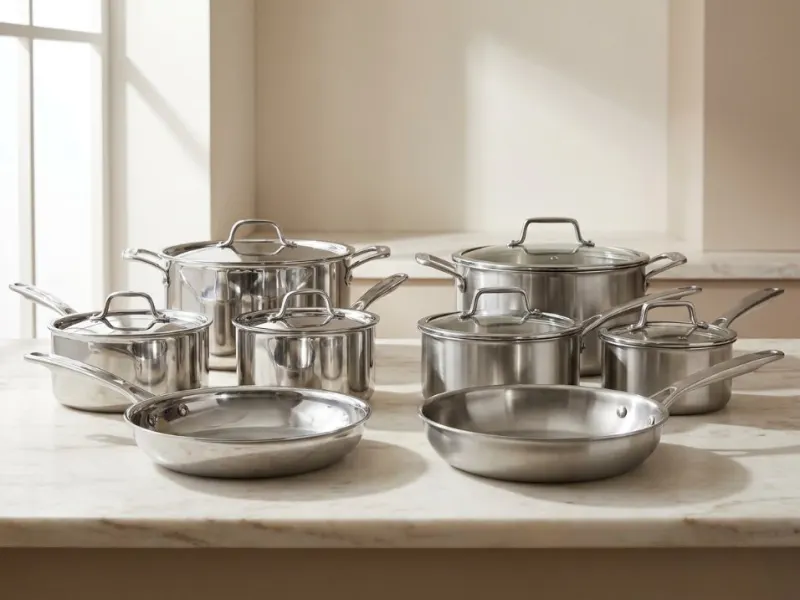
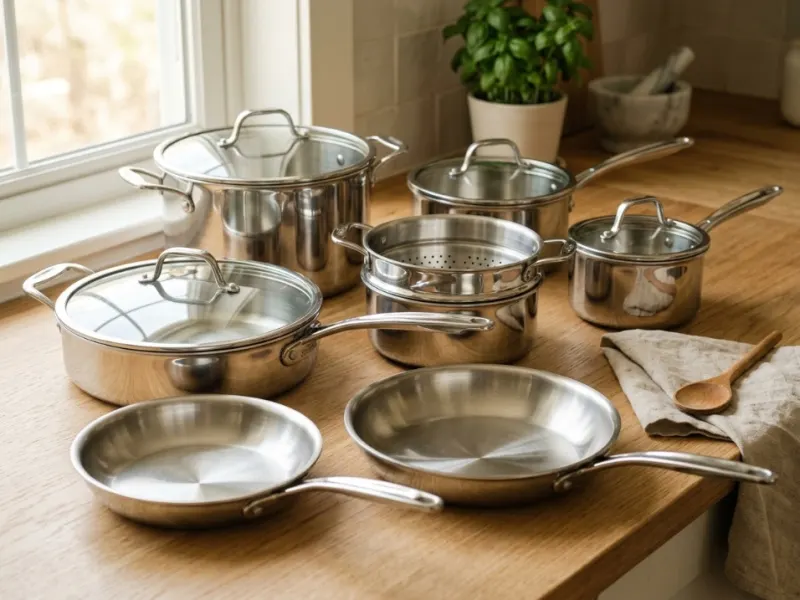
The set includes two saucepans (1-1/2- and 3-quart with lids), two skillets (8 and 10 inch), a 3-1/2-quart saute pan with lid, an 8 quart stockpot with lid, and a steamer insert that nests into the stockpot using its lid. That steamer is the piece that sets this apart from the Tramontina Tri-Ply Clad configuration, which r/cookware names as the other leading contender in this price range.
Each piece maps to a distinct kitchen job. The small saucepan handles reheating and melting. The 3 quart covers rice, oatmeal, and small-batch pasta.
The saute pan with straight walls and a lid is the real workhorse for one-pan meals and braises that need surface area plus liquid capacity. The stockpot covers full-batch pasta and stock production.
The configuration limitation is the skillet sizing. The largest skillet is 10 inches, which limits family-sized cooking. Most households that cook for 3 or more people reach for a 12-inch skillet as the daily driver. You would need to add the 12-inch MCP skillet separately.

The Preheating Technique That Makes Stainless Work#
Here is why people think stainless steel is hard to use, and why that perception dissolves within the first week according to owners who stuck with it.
The technique is the Leidenfrost test. Heat the empty pan on medium for 2 to 3 minutes, then flick water droplets onto the surface. When they form a single ball that rolls across the pan without breaking apart, the temperature is right. Add oil (it should shimmer immediately), then add food and leave it alone for 60 to 90 seconds.
Most new owners on r/cookware report that this technique clicks within their first week of daily use. The failure pattern is always the same: cold pan, food sticks, owner concludes stainless is defective. The pan is fine. The preheating step was skipped.
Both Tramontina and All-Clad state in their own care documentation that tri-ply clad cookware needs only low to medium heat. Tramontina's use-and-care sheet says directly that high heat causes sticking and scorching. The construction type itself (fully clad aluminum distributing heat efficiently) means you need less energy input than you expect.
This is why many guides miss it. They describe what to buy but never teach the one technique that determines whether stainless works or fails in your kitchen.
When This Set Is Wrong#
If most of your cooking is eggs, pancakes, stir-fry, and reheating leftovers, stainless steel is the wrong material for a primary set. Those tasks depend on food release, and nonstick or well-seasoned carbon steel surfaces will always be easier for that specific cooking profile.
A 12-inch carbon steel pan paired with a basic nonstick for eggs would serve an egg-dominant cook better than any stainless set at any price. We covered that material decision in our cookware material selector quiz, which walks through exactly this fork in about 30 seconds.
This set works for people who sear proteins, build pan sauces, simmer soups, make pasta, and occasionally fry. That covers most home cooks who prepare dinner from raw ingredients rather than reheating prepared food.
Construction Specs That Separate Good Sets From Frustrating Ones#
Three things to verify before buying any stainless set in this price range:
- Fully clad construction running aluminum through the sidewalls (the rim test above). Without this, the pan underperforms and you blame the material instead of the build.
- Riveted handles rather than spot-welded or screwed.
- Induction compatible bases. Even if your current stove is gas or electric coil, induction compatibility means the set works on any future cooktop upgrade without replacement. If you cook on induction, check the specific line in our induction compatibility checker before you buy.
The entire set is oven safe to 500°F, which means searing can start on the stovetop and finish in the oven without transferring to a separate dish. One owner notes that stovetop handles stay cool, but after oven use the handles retain heat longer than expected. Grab a towel when pulling from the oven.
For a longer look at when to buy a set versus building a collection piece by piece, our cookware sets versus individual pieces analysis covers the math. The short version: the set only wins if you genuinely use 6 or more pieces weekly.
How It Compares to the Premium Tier#
The natural next question is whether spending significantly more gets better cooking results. Owner reports across r/cookware and long-term comparison threads consistently describe the difference between a fully-clad budget set and a fully-clad premium set (several times the price for the same piece count) as limited to handle finishing, balance, and warranty rather than cooking performance.
The meaningful construction upgrade from tri-ply would be 5-ply, which adds extra aluminum layers for slightly more even heat distribution. Our 3-ply versus 5-ply comparison found the real-world difference is marginal for home cooking temperatures and timing. The budget tier gives you the same physics at a fraction of the ongoing cost.
The Cuisinart MultiClad Pro is our recommendation for anyone building or replacing a kitchen cookware set who cooks varied meals most nights. Learn the preheating technique first week, and the set handles everything else for the next decade or two.