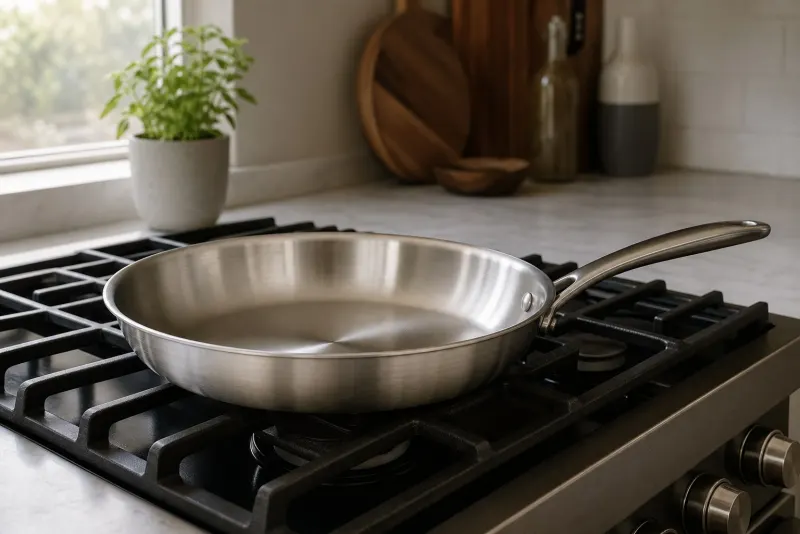
Gas creates a failure mode the product listings never mention: the flame reaches the sidewalls and handle base, degrading parts of the pan that electric stoves never touch. That tells you something no spec sheet will.
The best cookware for gas stove cooking is fully clad stainless steel or seasoned cast iron with riveted metal handles. If you want a single pan that will outlast the stove itself, we recommend the Cuisinart MultiClad Pro 10-Inch Skillet for its triple-ply fully clad construction at a fraction of premium pricing.
These materials handle the unique challenge of gas: an open flame that heats not just the bottom of your pan but wraps around the lower sidewalls and can reach the handle base. The Cuisinart MultiClad Pro solves this by running its aluminum core all the way up the sides.
Everything in this article comes from research synthesis: manufacturer specs, community data from r/cookware and r/BuyItForLife, and long-term owner reviews. The question most people ask is which brand to buy. The question that actually matters is what the flame is doing to the parts of your pan you cannot see from above.
The Mistake That Ruins Gas Stove Cookware#
The mistake we see again and again across every gas stove thread on r/cookware and r/Cooking: people use the same thin nonstick pans they used on electric and expect the same lifespan.
On an electric stove, heat transfers through flat contact. The element touches only the pan's bottom, and warmth rises through the sidewalls gradually by conduction. A thin single-layer nonstick pan works adequately because only its base ever reaches full cooking temperature.
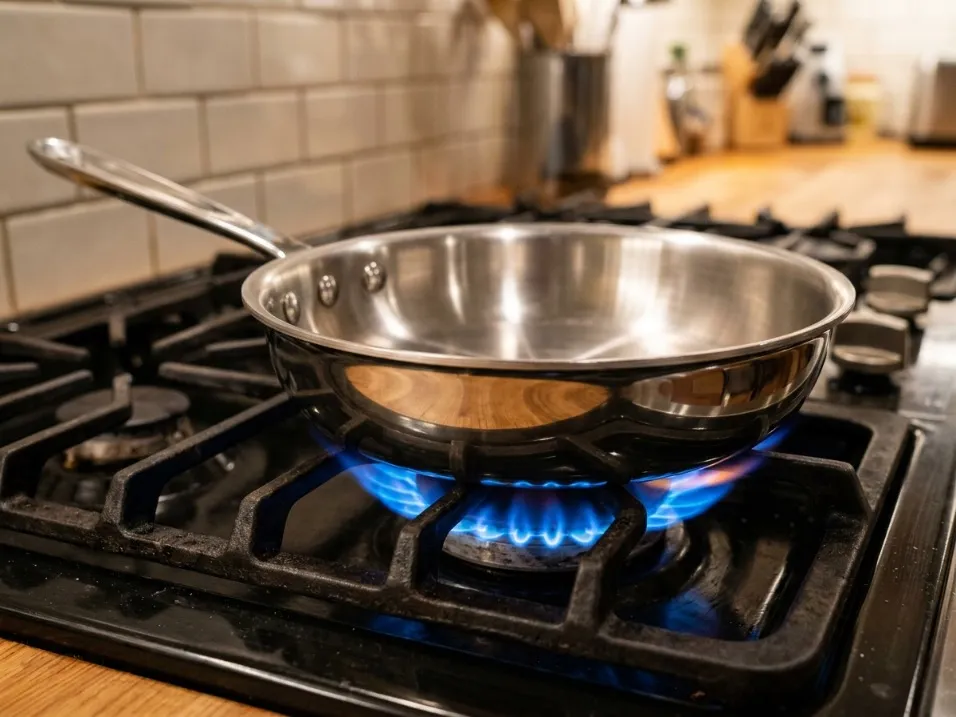
Gas works differently. The flame fans outward from the burner and licks up the sides of any pan sitting on the grates. Even on a medium setting, the lower inch of your sidewall receives direct flame contact. Owner reports on r/cookware describe this consistently, and the consequences stack up quickly.
PTFE coatings release fumes at temperatures as low as 500°F, with full pyrolysis beginning at 752°F, according to published toxicology research. The sidewalls of a thin pan in a gas flame can exceed the lower threshold while the cooking surface stays at a normal temperature.
Owners notice the coating failing first along that lower sidewall ring where the flame makes contact. This is the failure pattern that electric stove users never see.
The instant-on nature of gas also creates thermal shock that thin pans cannot absorb. You turn the burner from off to medium-high and the pan gets full heat within seconds. Electric elements ramp up gradually.
That sudden stress warps thin pans. Owner reviews consistently describe this as one of the earliest failures.
The Handle Problem Nobody Mentions#
Gas flame reaches the handle attachment point directly. On electric, handles stay cool because heat only travels through the pan body by conduction. On gas, the flame licks up the sides and contacts the handle base.
This is both a durability problem and a safety concern. Most buyers never think to check whether their handle material can tolerate the environment gas creates.
Choose pans with solid riveted stainless steel handles for gas stove use. They tolerate direct flame contact indefinitely.
What Actually Lasts on a Gas Stove#
The best cookware for gas stove use shares three traits that address the flame-wrap problem.
Fully clad construction. Tri-ply or 5-ply pans with the aluminum core running all the way up the sidewalls spread heat evenly and resist warping. Look at the sidewall of any pan you are considering.
If the aluminum layer stops at the base (disc-bottom construction), the sidewalls heat unevenly. That makes the pan more prone to thermal stress on gas.
Uncoated or resilient surfaces. Stainless steel, bare cast iron, and carbon steel cannot degrade from sidewall flame contact because there is no applied coating to break down. The cooking surface is the material itself.
Metal handles with riveted attachment. Stainless steel or cast iron handles tolerate gas flame contact without structural compromise. No plastic, no Bakelite, no silicone sleeves in the flame path.
Here is the reader's test: look at the sidewall of your pan. If it is bare metal all the way up with a metal handle, gas cannot hurt it. If there is a coating on the sidewall or a plastic handle, gas flame will eventually reach both.

Best Cookware for Gas Stove: Stainless Steel#
Fully clad stainless steel is the most versatile material for gas stove cooking. The aluminum core provides even heat distribution while the stainless exterior handles flame contact, grate scratches, and thermal shock without consequence. For a quick personalized recommendation based on your cooking habits, try the material selector quiz.
The Cuisinart MultiClad Pro 10-Inch Skillet is our value pick in this category. Cuisinart's own specs confirm triple-ply construction with a core of pure aluminum bonded to a stainless interior and a brushed stainless exterior. Their Heat Surround technology keeps the temperature even across the bottom and up the sides.
The riveted stainless-steel handle stays cool on the stovetop and handles gas flame contact. At 10 inches, the cooking surface is small for families of three or more, so consider the 12-inch model if you cook larger meals. That is what we recommend for gas stove buyers.
The tradeoff with any uncoated stainless pan is that food sticks without proper preheat technique. You need to learn the water-bead test and build confidence with oil timing. Owners on r/cookware report the learning curve is short, typically a handful of cooking sessions.
This matters for gas-stove buyers switching from nonstick. The very reason you need new cookware (gas killed your coating) also means you are learning a new surface at the same time.
Tramontina Tri-Ply Clad is the other frequently recommended budget option in those same threads, performing similarly at a comparable price tier.
Cast Iron and Carbon Steel on Gas#
Cast iron and carbon steel do not merely survive gas. They benefit from it.
Cast iron's thick walls absorb thermal shock that would warp lighter cookware. The seasoned surface cannot degrade from flame contact. Lodge's cast iron skillet (the 12-inch model) weighs 7.9 lbs per its official Amazon listing. That mass is the point.
It stores enough heat energy to keep searing temperature when cold food hits the surface.
Carbon steel occupies the middle ground. Owners consistently report that carbon steel heats up faster than cast iron and responds to flame changes more quickly. High heat builds better seasoning, and the quick temperature response lets you control exactly when browning begins. If you're new to the material, our carbon steel for beginners guide covers seasoning and the first few cooks.
Both materials handle gas without degradation. The high heat that kills coatings is harmless to bare iron and steel.
If you have limited cabinet space, one fully clad stainless skillet as the daily driver plus one cast iron piece for searing covers most of your cooking.
When Nonstick on Gas Still Makes Sense#
Nonstick is not forbidden on gas. It just requires different expectations.
If you use nonstick only for eggs and fish on a small burner at low-to-medium heat, the flame-wrap issue shrinks. Here is what works, per owner advice on r/Cooking:
- Never go above medium heat. The sidewall coating is your weak point, not the base.
- Match pan to burner size. A 10-inch pan on a large power burner means flame going past the edge.
- Treat it as a consumable. Budget for faster replacement than you would on electric.
The real mistake, in our view, is spending significantly more on a premium nonstick expecting it to last longer on gas. The coating chemistry is the same regardless of price tier. PTFE degrades at 500°F whether the pan cost a little or a lot. Our cookware safety checker lists which lines are bare metal and which carry a coating, with the source quoted for each.
The sidewall flame reaches that threshold on any thin pan. For a deeper look at why nonstick pans stop working in general, that article covers the failure modes that gas only accelerates. If you have noticed your pan warping or spinning on the grate, the underlying issue is thermal stress covered in why pans warp.