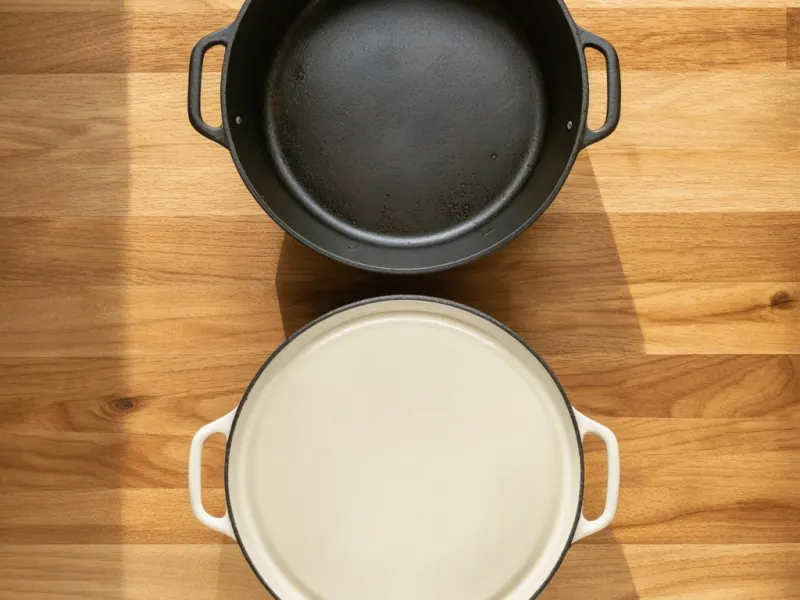
Two skillets sit on Lodge's own shelf right now. Same Tennessee foundry. Same factory quality control. Same iron. Pick one up in each hand, though, and one is about 1.3 pounds lighter than the other.
That difference sent us digging through Lodge's own listings, an independent reviewer's side-by-side comparison, and owner reports on the budget cast iron competition, to find out what actually changes at this price and what does not.
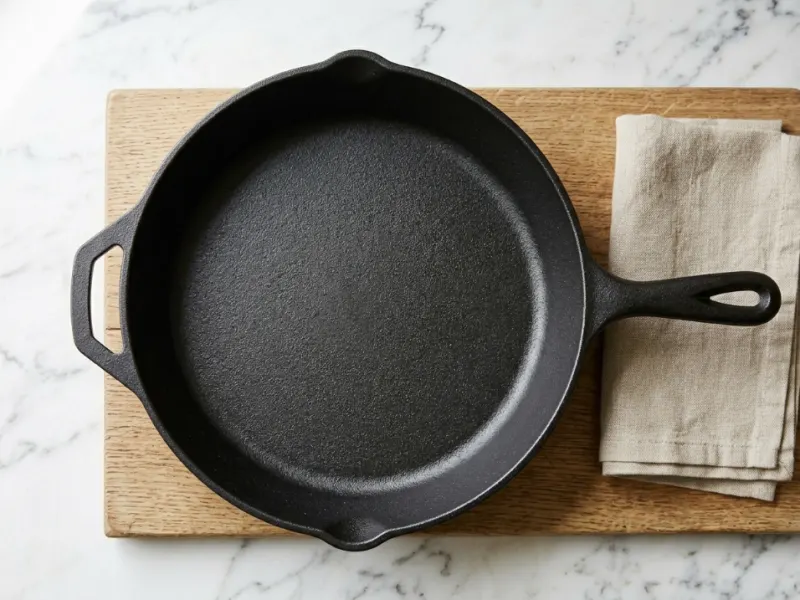
The best cast iron skillet under 50 is the Lodge Chef Collection 12-Inch.
Our cast iron cookware guide covers the ownership habit and the enameled alternative, if lighter weight isn't the only thing on your list.
It weighs about 6.55 pounds against 7.9 pounds for the standard Lodge Classic 12-inch. That 1.3-pound gap comes from wall shape, not the base, as the next section traces in detail. You get a lighter, easier-to-flip pan without giving up the thick base that actually holds heat. Availability varies by retailer, so check whether your size sells standalone before assuming you need the two-piece set.
That 1.3-pound gap is not a shortcut. It is a choice Lodge made on purpose. Once you see the mechanism, it changes what you should compare when you shop this category.
Best Cast Iron Skillet Under 50: The Mistake Shoppers Make#
Cast iron is iron and carbon, cast in a sand mold. The raw material cost is low. Shoppers assume every skillet at this price is basically the same metal with a different label.
That assumption breaks the moment you compare two pans from the same brand. The Lodge Classic 12-inch and the Chef Collection 12-inch are not different quality tiers. They are different wall shapes.
Lodge's own product listing notes the Chef Collection's sidewalls as spatula-friendly, a deliberate design feature rather than a side effect of cutting cost. Lodge's listing does not spell out exactly where the 1.3 pounds goes, but one hands-on reviewer who compared both pans side by side observed the difference is in that upper-wall taper, not the base.
An independent reviewer (Cast Iron Dude, a home cook who posts side-by-side cast iron comparisons) laid a Chef Collection and a standard Lodge skillet next to each other and reports the same tradeoff firsthand. The standard pan's steeper walls hold more flat cooking surface. The Chef Collection's rounder profile trades some of that surface for easier spatula access, and the reviewer reports its main handle as noticeably more comfortable to grip. Lodge's own listing separately credits the assist handle for giving "great control" when moving the pan.
Neither pan is the corner-cut version. If a listing says a budget skillet is lighter, ask what changed to make it lighter. Sometimes that is a thinner base, which genuinely hurts heat retention. Here, it is a taper in the walls above the food, which barely touches how the pan cooks.
Where Budget Cast Iron Actually Differs From Premium#
A common shortcut in this category says all cast iron cooks the same regardless of price, so buy the cheapest. That holds up for durability. It does not fully hold up for how a pan behaves on day one.
Food-science YouTuber Adam Ragusea fried eggs in three pans side by side: a rough, brand-new modern budget pan, an antique hand-smoothed pan, and a mirror-polished modern premium pan, all with matched heat and oil. The egg tended to stick less on both smooth surfaces. It stuck noticeably more on the rough one.
That is one documented test, not an industry-wide finding. It does line up with the basic mechanism, though. A rough factory surface gives food more microscopic pits to grab before seasoning fills them in.
Technique still does most of the work, even on a rough pan. A separate home cook (PapaMau) cooked French omelets and frozen dumplings, two of the harder foods to release cleanly, on a brand-new, unpolished Lodge Chef Collection straight out of the box. No extra seasoning, just careful heat and fat management. Neither dish stuck.
That single account does not make seasoning optional. It shows a rough surface out of the box is a starting condition you manage with technique, not a permanent flaw. At this price, the surface you get on day one genuinely behaves differently from a machined-smooth premium pan. What closes that gap over the following weeks is cooking on it, not spending more money.
Victoria: The Other Budget Name Here#
Victoria, a Colombian foundry making bare cast iron, sits in the same price range as Lodge and deserves a look before you decide. One owner comparing the two brands directly reported the Victoria has "a much smoother finish" than a rough-cast pan. A second Victoria 12-inch owner described it as "not that rough as some, not smooth, but smoother."
Two independent owners report the same direction: Victoria's surface starts a step ahead of Lodge's standard finish, without matching a fully machined-smooth premium pan. That is one real, sourced difference in surface finish alone, not a claim that the two brands are equivalent on weight, price, or anything else. If a smoother out-of-box surface is what you are after and both are on the shelf in front of you, that is the one factor with evidence behind it.
Watch for the Sold-as-a-Set Trap#
Lodge sells the Chef Collection as a two-piece set (10-inch and 12-inch together) directly on its own site, and does not always list the 12-inch alone there. Several other retailers do carry the 12-inch on its own, at a lower cost than buying the set just to get one pan.
Before you check out, search for your exact size sold by itself. If a retailer only shows the bundle, try a different retailer rather than assuming the set is your only path to this skillet.

Alternatives Worth a Look#
The Lodge Classic 10.25-inch is the pan a lot of cooks start with. It stays the simplest starting point if you cook for one or two people and do not need the Chef Collection's lighter feel. If size matters more to your kitchen than wall shape, our 10-inch vs 12-inch skillet breakdown covers that tradeoff in more depth.
Getting the Most Out of Either Pan#
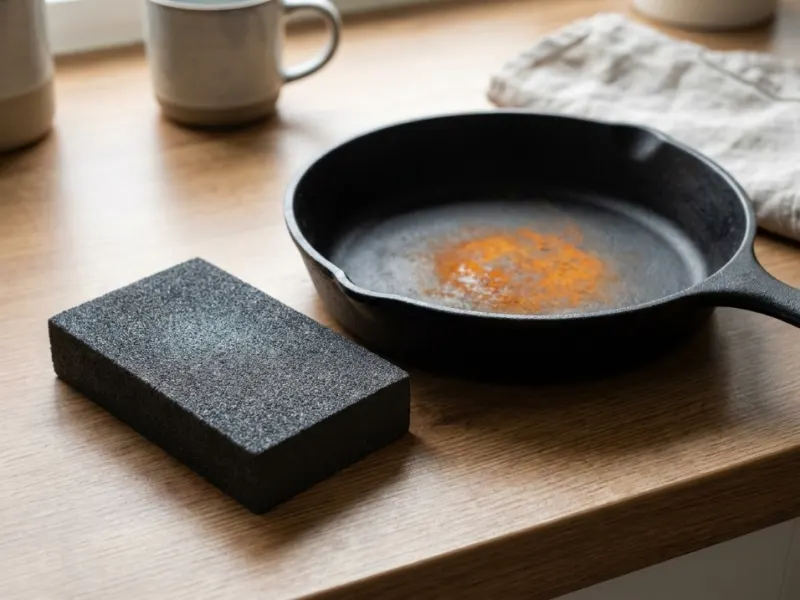
A rough factory surface, on any brand, sometimes ships with an under-cured factory seasoning layer that feels tacky instead of dry. If that happens on your first or second cook, do not panic and strip the pan.
Wipe on a thin layer of oil and heat it upside down in a 450°F oven for about an hour. That finishes curing the layer, leaving a surface you can rebuild. Our guide to fixing cast iron seasoning covers the full process if a tacky spot sticks around.
Cast iron rarely fails outright. It needs the basics: dry it on a hot burner after washing, wipe on a thin oil layer, and never let it sit wet. Do that consistently and neither pan asks for much beyond it, at a fraction of what a coated nonstick pan costs to keep replacing over the same years. Run that math against your own kitchen with our cookware cost calculator instead of taking our word for it.
Best Cast Iron Skillet Under 50: Our Pick#
Ask yourself how the pan actually moves in your kitchen. Most home cooks flip food by lifting and tilting the pan itself, rather than working it with a spatula alone, and that 1.3 pounds shows up on every stir-fry or omelet session. For that reason, the Chef Collection 12-inch is our pick.
If your pan mostly stays put on the burner while you sear or braise, the calculus flips: the extra flat surface on the Lodge Classic 12-inch matters more than the weight, since you rarely lift a searing pan mid-cook anyway. In that case, the Classic is worth the extra 1.3 pounds.
Either way, you are buying the same foundry and the same quality control. The difference is wall geometry, and now you know exactly what that 1.3 pounds bought you.