On Amazon, the rectangular double-burner cast iron griddle carries far more reviews than every round model combined. According to long-term owner threads on both Amazon and r/castiron, it is also the griddle most likely to end up stored permanently rather than used regularly. The pattern across both Amazon long-term reviews and r/castiron threads is consistent: owners who match the griddle shape to their actual burner layout use it weekly for years, while owners who defaulted to the largest available option get frustrated with uneven heating and stop pulling it out.
The best cast iron griddle is the one that physically fits how your stove delivers heat. Owners on Amazon and r/castiron consistently report that a round griddle on a single burner heats edge-to-edge with minimal effort, a rectangular griddle across two matched burners handles family-sized batches, and a square griddle splits the difference for those who want more area on one burner.
Our cast iron cookware guide covers the ownership habit and the bare-vs-enameled decision that come before shape and size.
We spent weeks digging through owner reports, manufacturer specs, and community threads to map exactly which shape works on which setup.
Here is what makes this question harder than it looks: most griddle complaints are not about the griddle. They are about the burner. The same Lodge Pro-Grid earns opposite reviews from owners with different stove configurations. Once you understand why, picking the right one takes about thirty seconds.
Why Shape Determines Whether You Actually Use It#
Every roundup article ranks cast iron griddles by brand reputation and material quality. That framing misses the real variable. The thermal properties between Lodge, Camp Chef, and Victoria differ less than the geometry-to-burner interaction that determines daily usability.
A round griddle sits on one burner. The heat pattern from the element, whether gas ring, electric coil, or induction disc, matches the cookware footprint. Heat distributes edge-to-edge without cold zones.
A rectangular griddle spans two burners. Amazon and r/castiron owners consistently report that it needs 10-15 minutes of patient preheating on medium-low before the full surface heats evenly. This single behavior variable, preheat patience, explains why the same product earns both glowing praise and frustrated complaints.
A square griddle sits on one burner but extends its corners beyond the circular heat element. On gas stoves where the flame ring spreads wide, the corners run slightly cooler but still usable. On electric coils or small induction elements, owners on both r/castiron and in Amazon reviews report the corners running noticeably cooler than the center.
Round Griddles: The Single-Burner Standard#
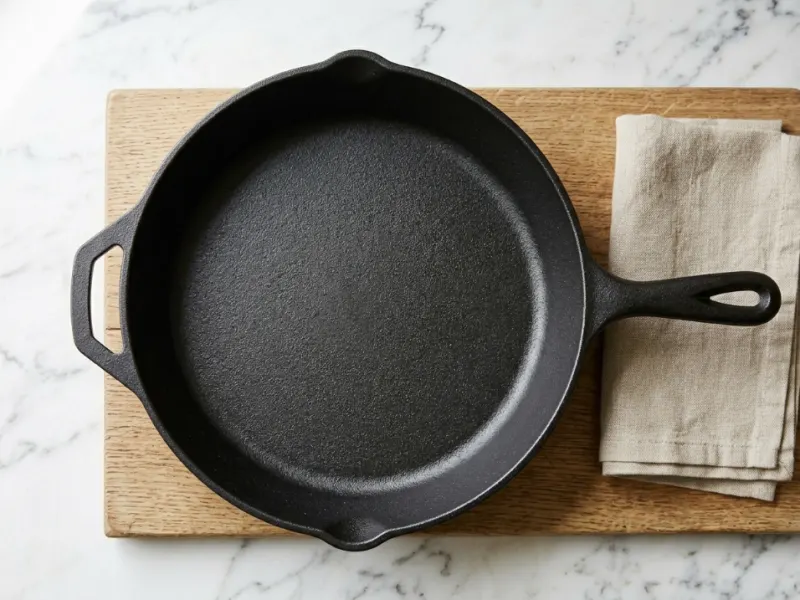
A 10.5-inch round cast iron griddle fits one standard burner perfectly. The cooking surface aligns with the heat element beneath it, delivering consistent temperature from center to rim. You get space for three pancakes, two eggs side by side, or one large quesadilla.
The tradeoff is capacity. For a solo cook or a pair, that is plenty for weeknight dinners. For a family of four on Saturday morning, you cook in batches. The low walls, typically half an inch or less, make flipping effortless because a wide spatula slides completely under food without catching a sidewall.
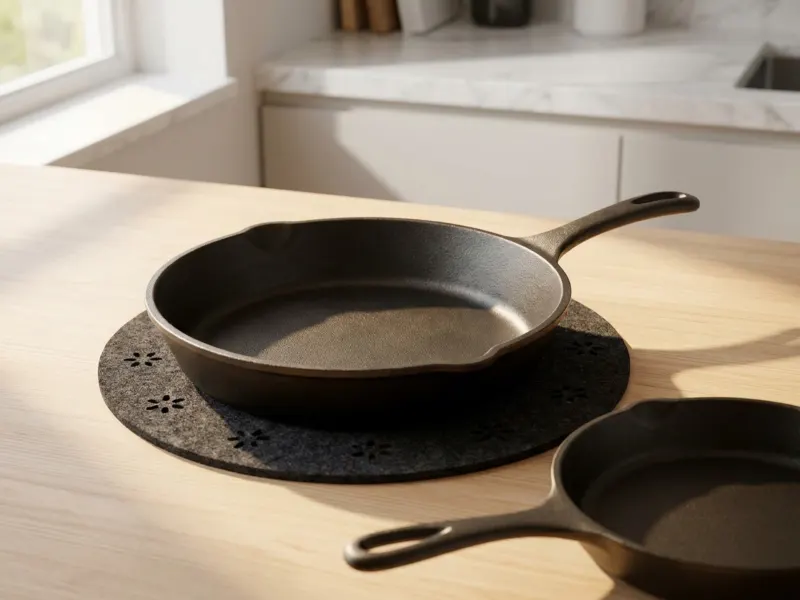
At 4.38 lbs per retailer specs, the round griddle is also the friendliest option for glass top stoves. Less weight means easier lifting (never slide cast iron on ceramic glass) and less cracking risk if you set it down firmly. Cast iron works natively on induction cooktops.
Best for: pancakes, crepes, grilled cheese, tortillas, single-serving smash burgers. Anyone who values even heat without tricks over raw cooking area.
Rectangular Griddles: The Dual-Burner Workhorse#
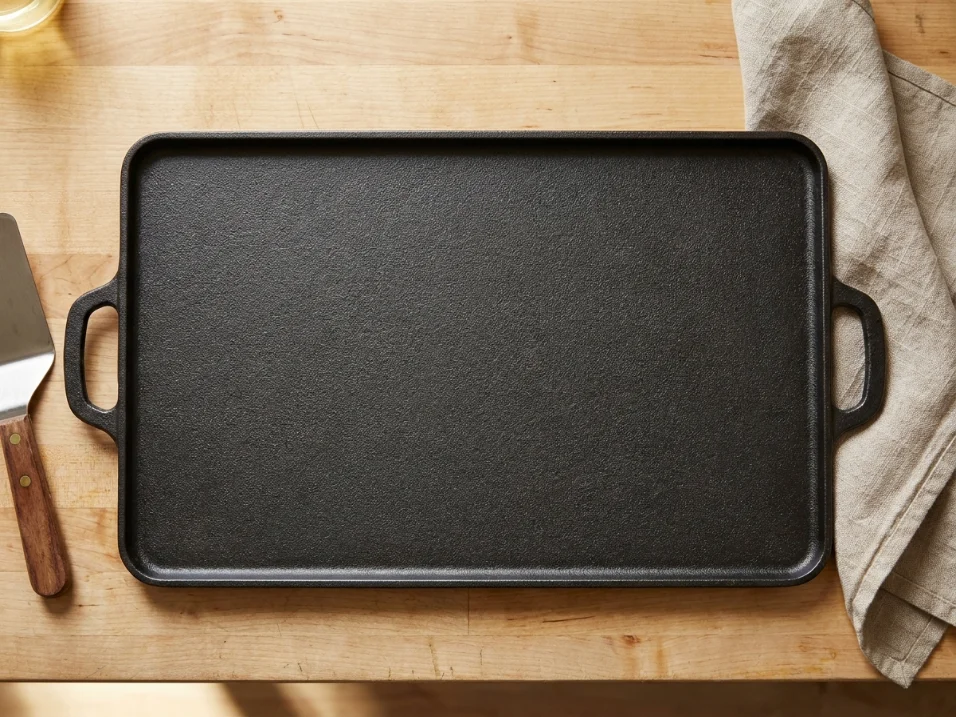
A 20-inch rectangular griddle gives you significantly more cooking area than a round. That is the territory where you line up an entire breakfast spread or eight smash burger patties in a single cook.

The shape genuinely excels for certain foods. Bacon strips lay flat across the full length. Multiple rows of pancakes cook without staggering. You can run two burners at different temperatures to create hot and cool zones simultaneously.
The catch is commitment. The Lodge LPGI3 weighs 13.5 lbs. That is a two-hand lift every time you move it from cabinet to stove, stove to sink, and sink back to storage.
The consistent pattern in long-term owner threads: people who leave the griddle on the stove permanently use it constantly, while people who store it in a cabinet gradually stop reaching for it. If your stove layout cannot accommodate a permanent resident, honestly consider whether you will keep pulling out a 13.5-pound slab for Tuesday night pancakes.
The preheat requirement is real. Amazon reviewers and r/castiron owners alike report that 10-15 minutes on medium-low across both burners produces even, predictable results. Those who skip or rush that window consistently describe a hot center with lukewarm edges.
Best for: families cooking on two dedicated burners, batch meal prep, anyone willing to let the griddle live on the stove.
Square Griddles: The Overlooked Compromise#
An 11-inch square griddle gives you noticeably more cooking area than a 10.5-inch round while still fitting on a single burner. The extra inches along each edge translate directly into space for wider foods that would overhang a round.
The drawback is physics. Square corners extend beyond the circular heat pattern of most elements. On gas stoves where the flame ring spreads wide, this is barely noticeable after preheating. On electric coils or small induction discs, the corners run measurably cooler.
The workaround that owners on both Amazon and r/castiron have settled on: rotate 45 degrees midway through preheat so corners trade places over the heat source.
Best for: the single-burner cook who wants more area than a round without dedicating two burners. Works best on gas stoves.
The Best Cast Iron Griddle for Your Setup#
The decision maps to your burner layout:
One available burner, cooking for 1-2 people. Round griddle. The Lodge L9OG3 at 10.5 inches heats perfectly on a single element with no tricks required.
Two available burners, cooking for 3+ people. The Lodge Pro-Grid Reversible Grill/Griddle at 20 x 10.5 inches with a reversible flat and ridged design gives you maximum cooking surface and dual-surface versatility at a budget-tier price.
One burner, wanting more area than a round. The Lodge 11-inch square gives you extra capacity within a single-burner footprint. Best results on gas.
Glass top or weight sensitivity. Start with the round. Under five pounds versus 13.5 for the Pro-Grid, with none of the cracking risk that comes from maneuvering heavy cast iron over ceramic glass.
The honest downside of our top pick: the Lodge Pro-Grid's perimeter grease channel is shallow enough to overflow during fatty cooking like thick-cut bacon. Multiple Amazon reviewers cite grease running off the edges onto the stovetop. At 13.5 lbs it will slowly migrate to permanent cabinet storage if you do not commit to leaving it on the stove.
Accept those tradeoffs if you genuinely cook for a crowd on two burners. Skip the Pro-Grid entirely if your typical weeknight is three pancakes for one person.
Quick Maintenance#
Griddles are simpler to maintain than skillets because the flat surface has no corners where food residue hides. The routine that works, per Lodge'''s own care guides:
- Clean while still warm. Run hot water over the surface and scrub with a stiff nylon brush or chain mail scrubber.
- A small amount of mild dish soap is safe on pre-seasoned cast iron. Lodge confirms this in their current care documentation. The old "never use soap" rule dates from an era of lye-based detergents that no longer exist.
- For stuck food, sprinkle coarse salt and scrub with the brush. Rinse thoroughly.
- Dry immediately and completely. A minute on a warm burner evaporates remaining moisture from the porous surface.
- Apply a thin layer of canola or vegetable oil across the entire surface. Wipe until it looks nearly dry. Store.
The most frequently cited cause of griddle rust across Amazon and r/castiron owner reports is air-drying rather than active heat-drying. Cast iron'''s heat retention that makes it excellent for cooking also traps moisture in microscopic surface pores.
For deeper seasoning guidance, see our guide on how to fix cast iron seasoning.
Reversible vs Flat-Only#
Reversible griddles (flat on one side, ridged grill on the other) promise two cooking tools in one. In practice, both Amazon long-term reviewers and r/castiron owners report using the flat side the vast majority of the time. The grill side comes out for occasional steaks or vegetables, then the griddle goes back to flat-side-up storage.
That does not make reversible models a bad choice. The flat side performs identically to a dedicated flat griddle, and the grill ridges add nothing to the weight or storage footprint. Just do not buy a reversible expecting it to replace a dedicated grill pan for high-heat searing.
If all you want is the best flat surface at minimum weight, a dedicated round or square flat griddle saves several pounds and stores more easily in a cabinet or on a wall hook.
For broader stovetop compatibility considerations, see our guide on best cookware for gas stoves. If you are curious whether your cast iron griddle can handle oven use, we covered which approaches work in bake in a cast iron skillet.
Everything above assumes gas, where the two-burner sizing question barely matters. On induction or a glass-top stove, that same two-burner griddle runs into a real limit. See griddle for gas stove vs. induction and glass-top for why bridging two zones there gets you two hot ends and a cold gap instead of double heating.