You bought the three-pack of baking sheets because it looked like the practical move. Weeks later, every one of them rocks like a see-saw on the oven rack, and the cookies on the edges burn while the ones in the center stay pale.
A baking sheet built to resist warping comes down to how it is made, not a gauge number you can look up. Almost no brand prints one. The pans that hold up over years are built like commercial equipment, heavy natural aluminum with a steel-reinforced rim. That is exactly how the Nordic Ware Naturals half sheet is made.
Here is the part that surprises people. We went looking for the gauge number ourselves and came up empty. Nordic Ware does not print one, and neither does the Amazon listing. That absence changed what we look for on a listing, because the answer is not a spec number at all.
The rim tells you what the gauge would. Pick up the pan and read the edge. A heavy rolled rim with steel inside is the warp-resistance signal. A thin folded lip is the warning sign for a pan likely to bow.
Beyond raw thickness, two design choices separate a pan that resists warping from one that bows. Almost no product page mentions either.
Why Cheap Baking Sheets Always Warp#
Digging into what actually causes a pan to warp, the physics is straightforward. Metal expands when heated, and in a thin pan the center (directly over the heat source) expands faster than the cooler edges. That uneven expansion creates stress, and when the metal is too thin to resist it, the pan buckles.
Thickness does most of the work here. A gauge number would put a figure on it, but the flimsiest pans skip the spec and skimp on metal. Those stamped grocery-store and department-store sets are too thin to hold shape. They flex under oven heat with a full tray on them.
A thicker pan carries more metal to move that heat around. The center and edges stay closer in temperature, so the stress never builds far enough to buckle it.
Material matters too. Natural aluminum conducts heat extremely evenly, which cuts down on the hot spots that drive uneven expansion in the first place.
What never works is bargain-bin stamped steel with a nonstick spray coating standing in for real construction.
A sheet that bows after only a few months is rarely bad luck. It is almost always a pan that was too thin for the job from the start.
What Actually Makes a Baking Sheet Warp-Resistant#
Three design factors decide whether a sheet pan resists warping.
Heavy, commercial-grade stock. Nothing compensates for a pan that starts out too thin. You judge it by a commercial or heavy-duty product line and by real heft in the hand.
Reinforced rolled rims. A rolled edge, where the metal curls back on itself at the rim, stiffens the sides so they cannot flex independently of the center. Nordic Ware encapsulates galvanized steel inside that rolled rim, and manufacturer specifications describe the construction explicitly as designed to prevent warping. Thick aluminum body plus steel-reinforced edges are the two features designed together to prevent that flex, while thinner sheets bow and buckle under heat instead.
Material stiffness or weight. Some materials resist bending better than others at the same thickness.
Aluminized steel, the approach USA Pan uses, is stiffer than pure aluminum at equal weight. Stainless steel is heavier still, so it takes more force to flex regardless of thickness. Both approaches show up in the recommendations below, and both solve the same problem from a different angle.
The Best Baking Sheet Built to Resist Warping: Nordic Ware Natural Aluminum#
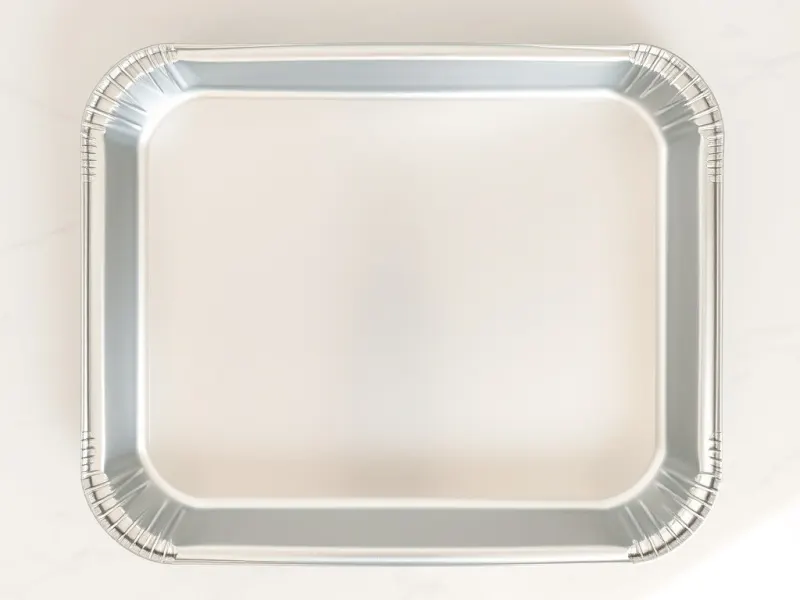
The Nordic Ware Natural Aluminum Commercial Baker's Half Sheet is heavy natural aluminum with those encapsulated steel rims. It is sold as a commercial line, carries a never-rust claim, and sits in the budget tier for a half sheet pan.
That thick aluminum and steel-reinforced rim are the construction behind its warp resistance, the same two features covered above. We read the Amazon and Sam's Club owner reviews looking for warp complaints. The negatives that surface are about discoloration, not bent pans.
Two owner reports we found agree on this. A verified Amazon purchaser says it "doesn't warp when very hot" (December 2020). A verified Sam's Club purchaser calls the pans "sturdy... no warping with high temps" (November 2022).
That darkening is the tradeoff. A verified Amazon buyer summed it up in 2018: "They do start to discolor quickly, but they work beautifully."
The trade-off is that parchment paper or a silicone mat handles release, since there is no coating here. Parchment costs pennies per sheet and gives a nonstick surface without anything that can degrade over time.
At its actual half-sheet size of 17.9 by 12.9 inches, it fits comfortably inside a standard home oven with room to spare on every side.
The Runner-Up: USA Pan Bakeware Half Sheet#

For nonstick convenience without giving up warp resistance, the USA Pan Bakeware Half Sheet takes a different route that works just as well. Instead of relying purely on thick aluminum, USA Pan builds this pan from aluminized steel reinforced with a steel bar rim, an approach that resists warping through rigidity rather than mass alone.
The corrugated bottom makes the surface harder to flex, the same principle behind corrugated cardboard. The Americoat coating on top is a silicone-based formulation rather than a traditional nonstick spray. Curious how deep we dig into a coating's actual construction before we cite it in an article? Our review methodology walks through the process.
USA Pan's advantage over Nordic Ware is convenience. Cookies release without parchment, and cleanup is faster.
The downsides run the other direction. American Pan, which licenses the Americoat coating, publishes a rating of 300 to 600 releases before refurbishment. The corrugated construction itself is a fixed design choice, not something a buyer can select around within this line. Natural aluminum never has a coating clock running, because there is no coating to lose in the first place.
When Stainless Steel Makes Sense#
For high-heat roasting where those browned bits stuck to the pan are the whole point, a stainless steel baking sheet like the TeamFar half sheet line is worth a look. Stainless steel is heavier and denser than aluminum, so it is physically harder to bend regardless of thickness. It is also non-reactive and carries no coating to wear out.
The trade-off is less even heat distribution across the surface. For roasting, that rarely matters, since the goal is browning, not uniform color from edge to edge. For cookies, where even browning in every corner of the pan matters, aluminum still wins.
The Baking Sheets to Avoid#
The warp complaints we read cluster on one kind of pan. They come in multi-piece sets marketed to people furnishing a first kitchen, they sit at the very bottom of the price range, they lean on phrases like "premium nonstick" while saying nothing about the metal or the rim, and they come from brands that do not specialize in bakeware at all.
Silence on construction is the real red flag. It is not the same as silence on gauge, since almost every brand skips that number anyway. What separates the pans that warp is a missing story about the build and the rim. When the only claim a listing makes is about the coating, assume the metal underneath was an afterthought.
How to Make Any Baking Sheet Last Longer#
Never run cold water over a hot pan. That sudden temperature swing can permanently warp even a thick, heavy-duty sheet. Let it cool first.
Avoid huge temperature jumps where possible. Sliding a cold sheet straight into a 450-degree oven stresses the metal more than a gradual warm-up. When a hot sheet is actually the goal for roasting, that is fine, just know the pan is being worked harder each time.
Never set one directly on a burner. The concentrated heat will permanently bend even a heavy, well-built sheet made to resist oven warping.
Store sheets flat rather than leaning them against other cookware. A slight bend introduced in storage tends to worsen the next time it hits real heat.
Related Reading#
If frying pans also warp on you, the same physics applies there too. The piece on why pans warp covers skillets, saucepans, and woks. For anyone building a kitchen from scratch, the first apartment cookware guide covers which categories are worth spending real money on. And if food sticks to regular pans rather than sheet pans, the guide on why everything sticks to stainless steel covers the technique side of that problem.
The Verdict#
Our recommendation for most home cooks is two Nordic Ware half sheets, not more. Skipping the nonstick coating is a fair trade, since parchment gives the same easy release without a surface that eventually wears out.
For anyone who bakes cookies often enough to genuinely dislike fussing with parchment, the USA Pan with Americoat is the better trade-off. Real nonstick convenience and still warp-resistant through its aluminized steel construction.