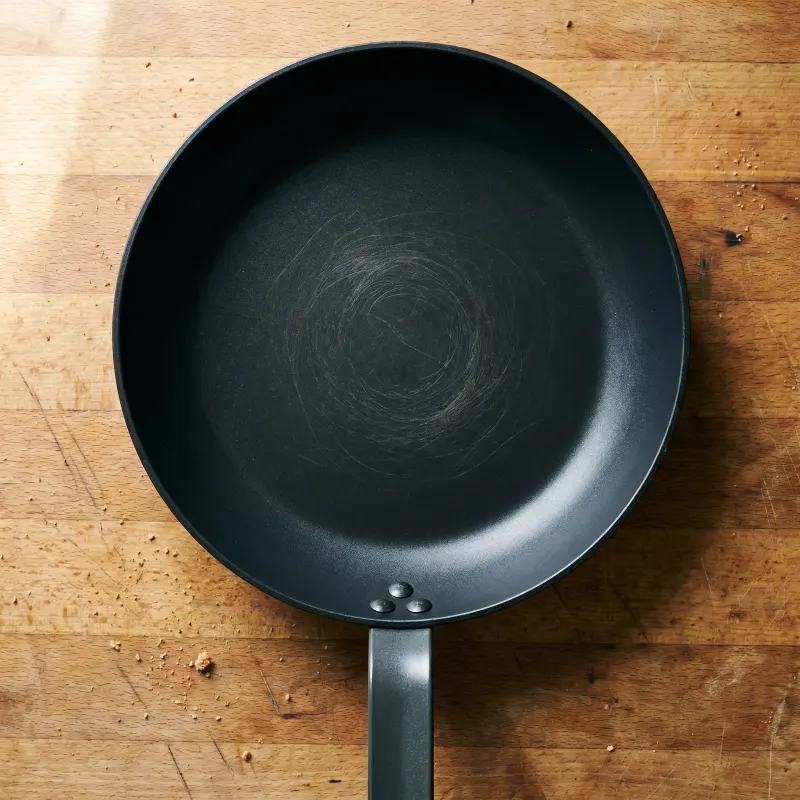
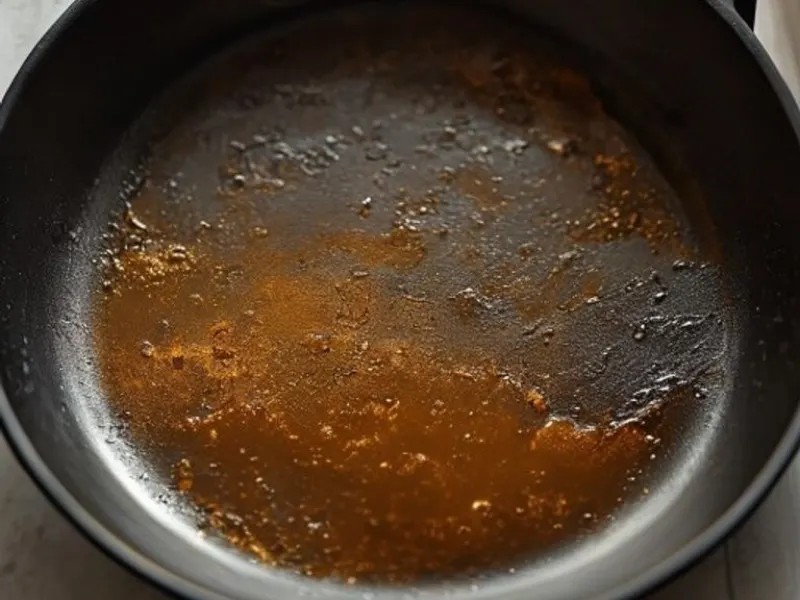
You scrub a rainbow-tinted pan with Bar Keeper's Friend and press harder because the discoloration won't budge. The pan comes out of the sink with fine scratch lines it didn't have before.
Bar Keeper's Friend on stainless steel works best as a finishing step, not a scrubber for stuck-on food. Its job is dissolving the invisible oxide layer, the rainbow or blue heat tint that soap and water never touch. Most of the scratches people blame on the product actually come from the wrong tool, used to fight food it was never built to remove.
Cleaning is only one piece of ownership. Our stainless steel cookware guide covers construction, induction compatibility, and whether a premium brand earns its markup.
The label calls for a soft cloth. In the demonstrations we reviewed from Joe's Phenomenal Kitchen and Living On A Dime To Grow, the pan that came out scratched was the one scrubbed with something else.
Why Bar Keeper's Friend Scratches Some Stainless Pans#
In the demonstrations we reviewed from Joe's Phenomenal Kitchen and Living On A Dime To Grow, the scratches did not come from the oxalic acid itself, the active ingredient behind the heat tint removal. They came from the scouring pad someone reached for while trying to force off stuck food. One verified Amazon buyer flags the same two-part mechanism: one owner describes "the mechanism of action of this product is two fold: 1) a minor abrasive," pairing it with the product's own chemical action.
Bar Keeper's Friend's own directions call for rubbing it in with a wet cloth or sponge, never a scrub pad. That instruction exists because the product's cleaning action is chemical first, not mechanical force. The powder carries a mild abrasive of its own, but oxalic acid does the actual dissolving on contact. It doesn't need an external scrub pad or steel wool on top of that to do the job.
Heat tint is a chromium oxide film on the surface of the pan, not a crust sitting on top of it. That film is what makes stainless steel self-healing in the first place: it regenerates on its own once exposed to air. Fighting a thin chemical layer with a green scouring pad or steel wool adds abrasive contact the reaction never called for. That's what leaves marks.
People treat this product like a heavy-duty scrubber because that's what stuck food seems to demand. But it isn't fighting food. It's fighting a surface reaction. More force just means more abrasive contact with your pan, for a job the chemistry was already handling on its own.
The Right Order: Clear Food First, Bar Keeper's Friend Last#
We compared two separate cooking channels covering this exact product on stainless steel: Joe's Phenomenal Kitchen and Living On A Dime To Grow. Both land on the same sequence, regardless of what they use to clear food first.
- Clear the bulk of the mess with something else. Soap and water handles light residue. A boiling water or baking soda soak handles anything stuck-on.
- Look at what's left. If the pan is food-clean but still spotted, clouded, or showing a rainbow tint, that's the actual job for Bar Keeper's Friend.
- Bring it in last, never first.
One channel tested three separate cleaning methods on the same discoloration, a pan-sauce deglaze, a baking soda soak, and a vinegar soak. Every method cleared the food. Every method left the same rainbow tint behind, untouched. Bar Keeper's Friend was the only step that removed it.
Food removal and discoloration removal are two different jobs, and one product doesn't do both well. That also explains why some people insist the product "doesn't work." They're testing it against baked-on food, the one job it was never built for. A scrub pad does the actual work of clearing that food, and leaves the scratches behind on its way out.
The Technique That Actually Prevents Scratching#
Once the food is gone, the discoloration step is simple, and how much product you reach for depends on what you're looking at.
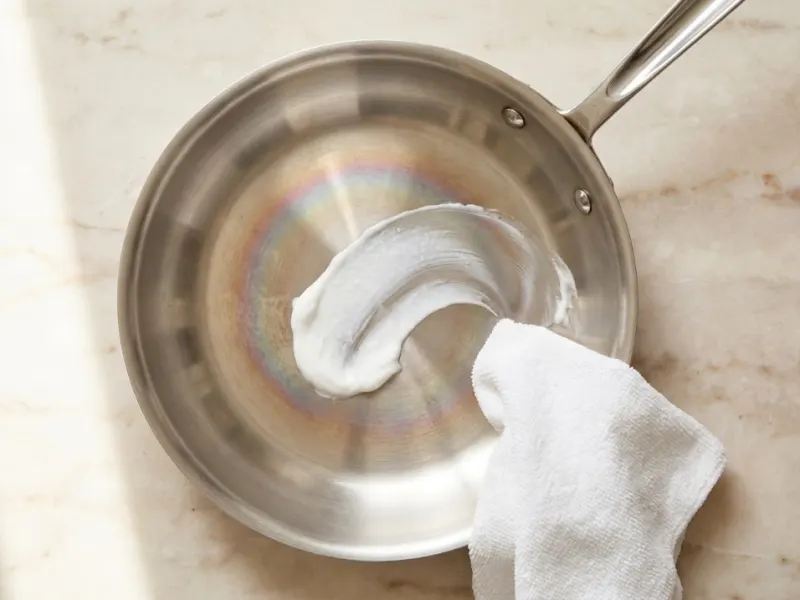
A light sprinkle-and-wipe handles routine dullness. Wet the surface, sprinkle a little powder, and rub it in with a wet cloth or sponge. That's the on-label default for most washes.
A thicker paste is for a stubborn spot that doesn't lift on the first pass. Mix in just enough water to turn the powder into a paste, no exact ratio needed. Don't reach for the paste as a first move. Save it for the spot the light pass didn't clear.
Either way, the tool matters more than the amount. Use a soft cloth or non-abrasive sponge, never the green scrub pad in your sink. Apply light pressure. If you feel like you need to lean into it, give the product a few more seconds to work instead of pushing harder.

Keep the whole thing under a minute for a paste application. That matches the label's own dwell-time cap for stains. This is a fast reaction, not a soak, and letting it sit longer doesn't clean better. It just raises the odds of pitting.
Rinse thoroughly under running water until no residue remains, then dry the pan right away. One more habit worth adopting: keep a sponge dedicated to Bar Keeper's Friend. Keep it separate from the one you use on food residue, so the two jobs never cross-contaminate.
How Often You Actually Need It#
This isn't a product for every wash. If soap and water alone leave your pan clean and shiny, there's nothing here for Bar Keeper's Friend to do that day.
It earns its spot on the washes where the pan is food-clean but visually dull. Hard water spots, a hot sear that left a rainbow ring, and the general haze that builds up over weeks of regular cooking all count. That's a periodic shine step for most home cooks, not an after-every-meal habit.

Treat it as a shine-restoration step, not a baseline habit, and a single container lasts a lot longer than that framing might suggest. One real tradeoff worth knowing about going in: the powder has to be wetted and mixed fresh every time you use it. It isn't sprayed and wiped the way a bottled cleaner works, so it adds a small extra step to a quick between-meal wipe-down.
What Bar Keeper's Friend Won't Fix#
It isn't a universal cleaner for every metal in your kitchen. The label itself rules out gold, silver (sterling excepted), polished stone, cast iron, and lacquered, painted, or mirrored surfaces.
The chemistry that helps stainless steel causes real damage on those surfaces instead.
The label also caps how long a paste can sit on a stain at 1 minute. That's a real limitation if you're hoping to leave it on a stubborn spot and walk away the way you might with a longer-dwelling degreaser. It isn't built for that.
Never combine it with bleach or any chlorine-based cleaner. The manufacturer's own safety data sheet puts the active ingredient at 5 to 10% oxalic acid. Per the CDC's report on chlorine gas toxicity from bleach mixed with other cleaning products, mixing an acid with bleach releases chlorine gas. The report documents confirmed institutional cases, but the chemistry is the same in a home kitchen, and that hazard applies to any acidic cleaner near bleach, not something specific to this brand.
If your pan is stuck with a heavier crust and not just discoloration, a boiling water deglaze or baking soda soak handles that first. We lay out that layered approach in more detail in our guide to cleaning burnt stainless steel.
Your real question might be less about scratching and more about whether the product belongs in your kitchen at all. We've gone through what's actually in the bottle and what the real risk is in a separate deep dive.
The bigger picture on that rainbow discoloration, why it shows up faster on some pans than others, is worth understanding too. We cover the actual causes of stainless steel pan discoloration if you want to slow it down between cleanings.
Most of the scratches people blame on Bar Keeper's Friend trace back to the tool, not the product. Clear food first, save the paste for the stubborn spots, and reach for a soft cloth instead of a scrub pad. Do that, and the pan that comes out of the sink should look better than it did going in, not worse. If you're shopping for this after reading, the Bar Keeper's Friend Cookware Cleanser & Polish is the one to keep under the sink.