Thousands of Amazon reviews sit on the various Granitestone listings. What we noticed digging through them: the positive reviews almost always describe the first few weeks of ownership.
Granite stone pans are worth it for light, occasional cooks who treat them as disposable nonstick and always use a thin layer of oil or butter.
For the fuller picture on how granite-style coatings compare to standard PTFE and ceramic, our nonstick cookware buying guide breaks down the buying decision by axis, not just by brand.
They are pressed-aluminum pans with a speckled PTFE coating that delivers genuine food release for the first several months to about 2 years, depending entirely on how you use them.
The pan is not worth it for anyone cooking daily or expecting it to last like cast iron or carbon steel.
The catch is that the marketing itself sabotages the product. The infomercial slides eggs around a dry pan. Owners who replicate that technique report sticking within days.
The ones who ignore the pitch and use fat have a perfectly adequate pan for a year or more. That gap between the advertising and the reality is where most of the disappointment lives.
What a Granite Stone Pan Actually Is#
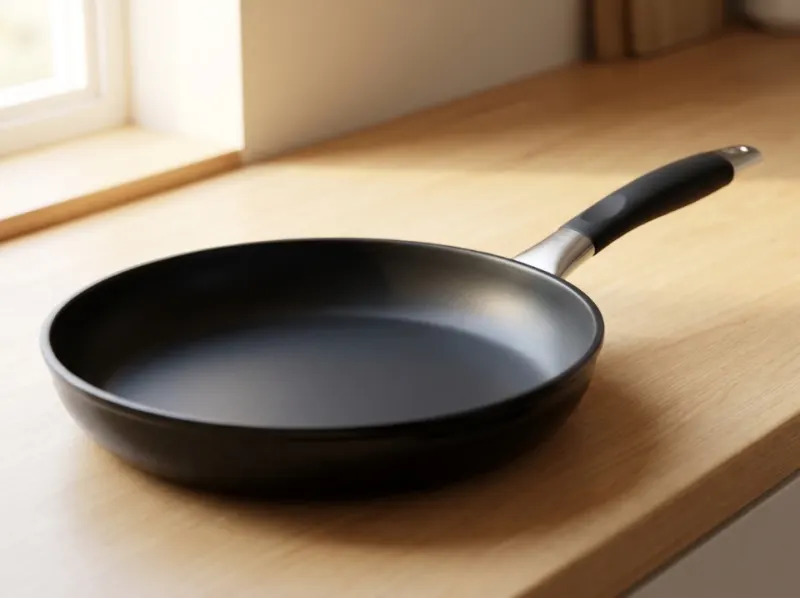
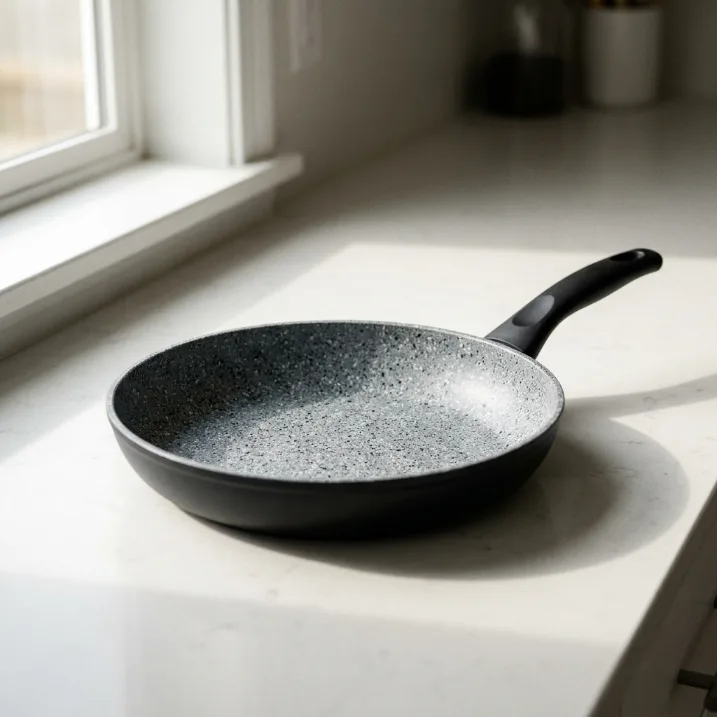
The name suggests carved rock. The reality is a lightweight pressed-aluminum body coated in 3 layers of PTFE. That is the same polymer branded as Teflon, reinforced with mineral particles for the speckled look. The granite appearance is cosmetic.
Names like "diamond-infused" and "mineral-enforced" across different Granitestone product lines describe additives in the same PTFE base, not a fundamentally different cooking surface.
E Mishan & Sons (Emson) owns the brand. They import from China, which the CPSC confirmed in its April 2026 recall notice. The pan is marketed as PFOA-free, which is standard across the industry since 2015 under the EPA's PFOA Stewardship Program.
It is not a differentiator. PTFE itself is FDA-authorized for food contact under 21 CFR 177.1550. For a sourced verdict on any specific brand and line, run it through our PFAS safety checker.
The basic pan is NOT induction compatible (aluminum body, no magnetic disc). It is rated oven safe to 500°F. The aluminum body makes it very light, which some owners appreciate and others flag as cheap-feeling.
Why the Marketing Kills the Pan#
Here is what we found that no competitor review explains. The infomercial shows food sliding off a completely dry pan. That claim is technically possible for the first few uses on a brand-new PTFE surface at controlled temperature. It is also the fastest way to destroy the coating.
Even PTFE needs a thin barrier between food and surface. Without oil, protein bonds to tiny surface imperfections. Each dry cook accelerates degradation at those contact points.
The owners who followed the infomercial's advice and cooked without fat report catastrophic results. One Amazon buyer tried eggs without butter on their first use: "it stuck to the pan!"
Another owner reports sticking "worse to these pans than my 100 yr old other nonstick pans" when cooking dry, adding in a later update: "I have to use oil in them every single time. They're still ok at best, if you use oil"
The owners who ignore the marketing and cook with butter or oil from day one tell a different story. One owner used the pan heavily for "about 2 years" with scrambled eggs, shrimp, and everything in between before the nonstick started fading. That is right in line with what we see across all budget PTFE pans, where owners commonly report 2-3 years with proper care.
The a-ha: the pan is fine. The instructions are the problem.
The Thin-Aluminum Tradeoff#
The pressed aluminum body is genuinely thin. Owners report two consequences:
- It heats up very fast but loses heat just as fast, which makes food easy to burn. One owner specifically notes "it heats up way too fast, and does not hold the heat very well so your food is easy to burn".
- Searing at high heat damages the coating. A Granitestone Armor Max owner warns: "Be weary of searing / using high heat to fry meat products as this may result in some damage to the non-stick coat".
This is not a Granitestone defect. It is the physics of thin-gauge stamped aluminum. Every budget nonstick pan at this price tier behaves the same way. The tradeoff is lightness and fast heating in exchange for poor heat retention.
You accept that or you pay more for a thicker body. For the physics of how thin aluminum warps under thermal stress, the full explanation is in why pans warp.

A Brand-Level Quality Signal#
In April 2026, the CPSC recalled about 740,000 Granitestone Diamond Pro Blue sauté pans. The defect: a metal cap on the handle screw could detach and forcefully eject when heated. Ninety-eight incidents were reported, including one injury with burns and bruising.
The recalled product is a different line from the basic frying pan reviewed here, but 740,000 recalled units from a single manufacturer is a quality-control signal worth noting when evaluating the brand's overall engineering standards.
Are Granite Stone Pans Worth It for You?#
Buy the Granitestone Nonstick Frying Pan if:
- You cook 3 or fewer times per week, mostly eggs, pancakes, or reheating
- You treat nonstick pans as disposable (replace when they stick, no attachment)
- You will use butter or oil every time (ignore the infomercial entirely)
- You want something cheap and light for a small kitchen or a first apartment
Skip it if:
- You cook daily and want a pan that improves with use
- You need induction compatibility (basic line does not work)
- You want to sear meat at high heat (coating will suffer, body is too thin to retain heat)
- You are tired of replacing pans every year or two
We worked through hundreds of owner reports across the Granitestone lineup. Our recommendation comes down to cooking frequency. For daily cooks, a cast iron skillet or a carbon steel pan costs about the same as two Granitestones and lasts decades, building a better nonstick surface the longer you use it.
If you are choosing between replacing a coated pan and buying one uncoated pan, the cookware cost calculator compares total spending over your chosen years using your prices. For someone who specifically wants nonstick that lasts longer than a year, the pans in our best nonstick pan that actually lasts guide use the same PTFE chemistry on thicker, better-constructed bodies.
The One-Sentence Verdict#
Buy the Granitestone pan, ignore the infomercial, use oil, and plan to replace it in about 2 years. At this price, that math works. Just do not expect anything more than that.