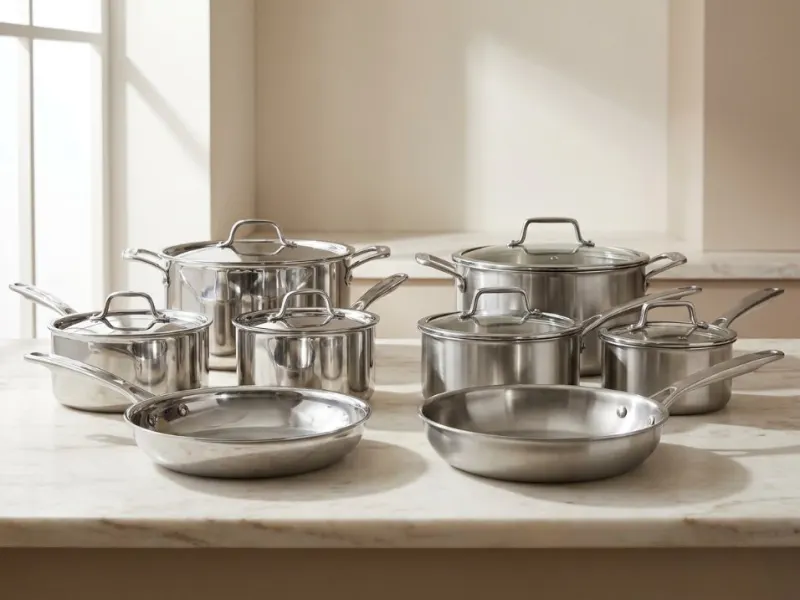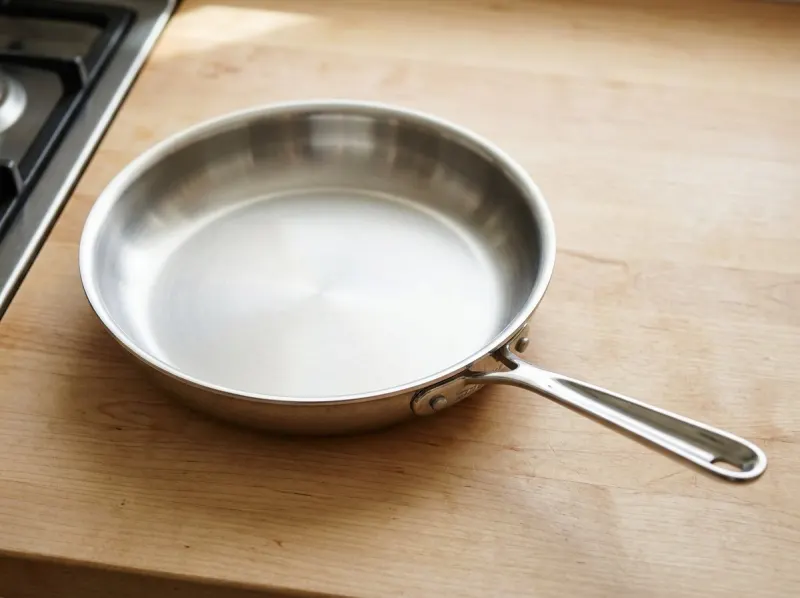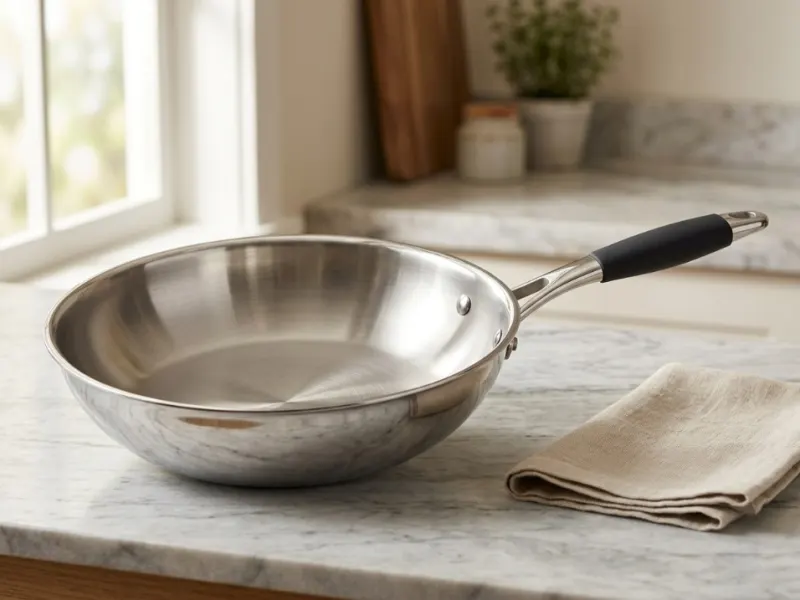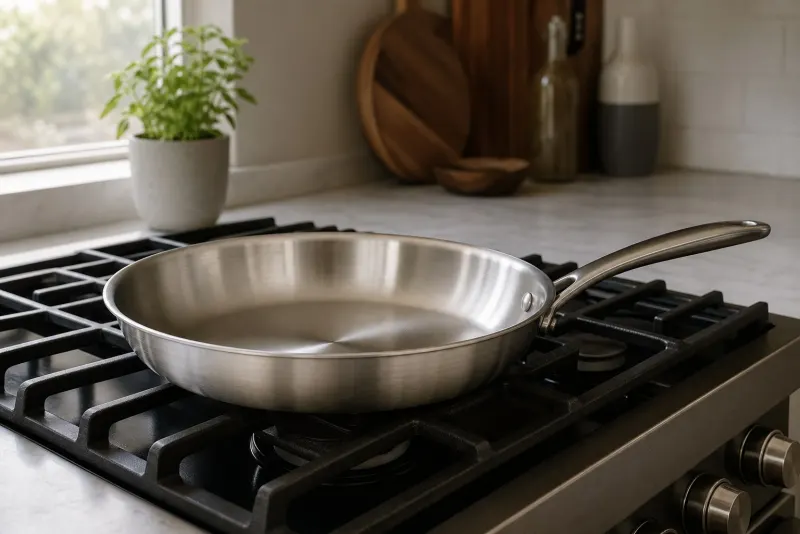
Same aluminum core. Same tri-ply construction. In the All-Clad vs Tramontina debate, one of these pans costs several times more than the other.
After checking current pricing and owner reports, we don't think the reason is the one most buyers assume.
On the 12-inch pans we compared, the All-Clad vs Tramontina price gap runs roughly 3x to 4x, not the 5x figure repeated across forums. It pays almost entirely for handle comfort, balance, and finishing rather than how the food turns out.
For the full buying decision beyond these two brands, our stainless steel cookware guide covers construction, induction compatibility, and care.
Both pans are fully-clad tri-ply and heat evenly up the sidewalls. Blind taste tests, by every account we could find, cannot tell them apart.
So what is that extra money actually buying, and is it worth it for the way you cook? We dug into current listings, long-term owner reports on r/cookware, and the underlying construction specs to find out. Our full process for checking claims like this is on the how we review page.
All-Clad vs Tramontina: They Cook the Same Food#
Both pans use fully-clad construction. All-Clad's own D3 product page describes its build as tri-ply, an aluminum core sandwiched in stainless steel that runs from the base up through the sidewalls. That's the feature that actually matters. The entire cooking surface heats evenly, not just the bottom.
Cheaper stainless pans, the kind found in department store sets, use a disc of aluminum bonded only to the base. Those pans have cold sidewalls where sauces pool and reduce more slowly. If the layered-construction distinction is new to you, our 3-ply vs 5-ply cookware guide covers why it matters more than the number of layers itself.
The water-droplet test, the same technique we cover in the stainless steel sticking guide, hits the right temperature at roughly the same point on either pan after a similar stretch of medium-heat preheating. Food releases the same way. Fond develops the same way.
Long-term reviewers across r/cookware consistently report side-by-side cooks of the same recipe producing indistinguishable results. The All-Clad D3 is also rated oven and broiler safe to 600°F, well above what either pan needs for stovetop searing. Our oven-safe temperature lookup shows each maker's stated oven limit, quoted from its own documentation.
Where the Price Actually Shows Up#
The differences between these pans are real, but they show up in the hand, not on the plate. Over hundreds of meals, ergonomics start to matter more than they do in a first impression.
The handle. The All-Clad D3 handle is longer and contoured with a slight upward angle that gives leverage when the pan is loaded. After searing four chicken thighs, the difference in wrist strain becomes noticeable over a long cook.
The Tramontina handle is shorter and straighter, functional but not shaped for extended heavy use. For quick weeknight meals this barely registers. For a Sunday project where the pan goes in and out of the oven three times, it adds up.
Balance on the burner. The All-Clad sits dead flat on a glass top stove and stays flat for years. Some owners report the Tramontina developing a slight wobble after extended thermal cycling, most often mentioned by glass-top cooks, though we couldn't pin down a reliable timeframe from the sources we checked.
It doesn't affect how the food cooks, but it shows up under spatula pressure. On gas with grates, this doesn't register at all.
Edges and rivets. The All-Clad pours sauces cleanly from a rolled lip without dripping down the outside, and its rivets sit nearly flush with the cooking surface. The Tramontina's rivets protrude slightly, so residue collects around them and costs an extra few seconds of scrubbing. Not a dealbreaker, but multiplied by hundreds of washes a year, it's a real quality-of-life difference.
The Real Price Gap, Verified#

We checked current listings rather than relying on the numbers that circulate online, and the gap is smaller than the "5x" figure that gets repeated. The All-Clad D3 12-Inch sits solidly in premium territory. The Tramontina Signature Tri-Ply Clad 12-Inch sits in budget territory.
Doing the math on the current listings puts the gap at roughly 3x to 4x for this specific size, not 5x. Smaller sizes can show a wider gap, which is likely where the higher figure comes from.
Spread across years of daily use, that gap narrows further. The Tramontina costs roughly a quarter to a third of the All-Clad upfront, and both pans are lifetime-tier stainless. Even accounting for a worst case where the Tramontina eventually needs replacing while the All-Clad never does, the All-Clad's upfront premium buys years of runway before that math would ever flip in its favor.
That's still a real difference in what each pan costs to own, but it's a smaller gap than the sticker price alone suggests, because both are built to last rather than to be replaced on a fixed schedule.
The math comparison is still striking either way. The All-Clad's price premium alone covers a full Tramontina skillet plus a carbon steel wok, with room left over.
One caveat on availability. Tramontina stock on Amazon is inconsistent. Some weeks the Signature Tri-Ply Clad is available at its normal price.
Other weeks it disappears or gets listed by third-party sellers at a markup. The right time to buy is when it shows up at a reasonable price from Tramontina or Amazon directly.
Make Sure You're Buying the Right Tramontina#
This is worth clarifying because Tramontina sells many product lines at very different price points, and not all of them compete with All-Clad. The one that does is the Signature Tri-Ply Clad, model 80116. It needs to say "Signature" or "fully-clad" in the listing.
Tramontina also sells a Tempo Tri-Ply Base line that has "tri-ply" in the name but is disc-bottom construction, not fully clad, and it will not perform like the comparison in this article suggests. Read the listing carefully and confirm the aluminum layer runs up the sides before buying.
Our Verdict#
For cooks buying their first stainless steel skillet, the Tramontina Signature Tri-Ply Clad is the right starting point. Learn on it, cook with it for a year, and let it reveal whether stainless fits your cooking style without risking serious money on the experiment.
For cooks who have been at stainless for years, love it, and stand at the stove daily, the All-Clad D3 is a legitimate comfort upgrade. The handle, balance, and finishing genuinely improve the daily experience once the learning phase is behind you. It's an upgrade for cooks who already know what they want, not a starting point.
Our honest take: the food tastes the same either way. If we had to pick one, we'd put the Tramontina in the cart and redirect the savings toward cookware that opens up new capability, a wok or a carbon steel pan, cabinet space permitting, rather than toward finishing details on a second stainless pan.
The Pan Won't Fix Your Technique#
One thing both pans have in common. They punish skipped preheating, an overcrowded surface, or an early flip equally. Brand and price don't change the physics of stainless steel.
If sticking is the actual problem you're solving for, our why everything sticks to stainless steel guide covers the technique fix regardless of which pan is in the kitchen. Our material selector quiz walks through this decision in about 30 seconds if you're still weighing materials generally.
Put the budget-tier price toward the Tramontina and put the rest toward groceries and practice. If Calphalon's stainless line is also on your list as a middle option, our Tramontina vs Calphalon comparison covers where that extra money goes.