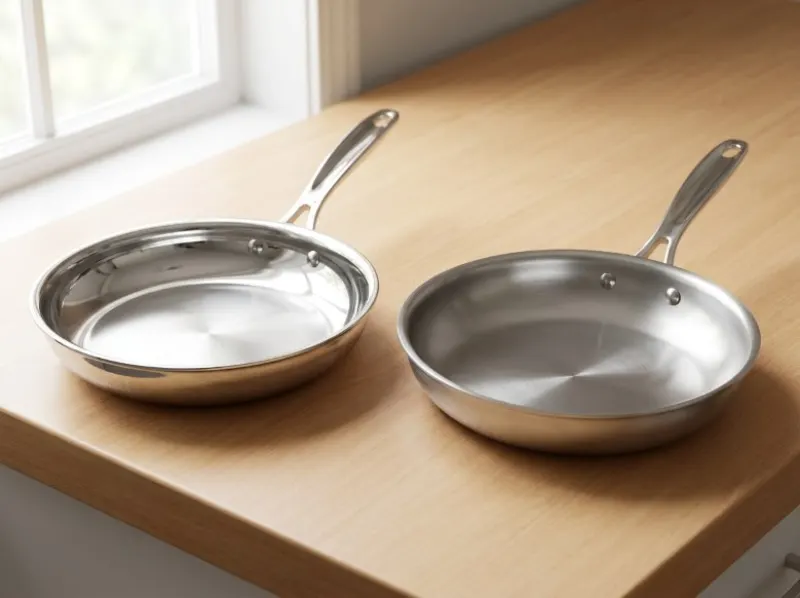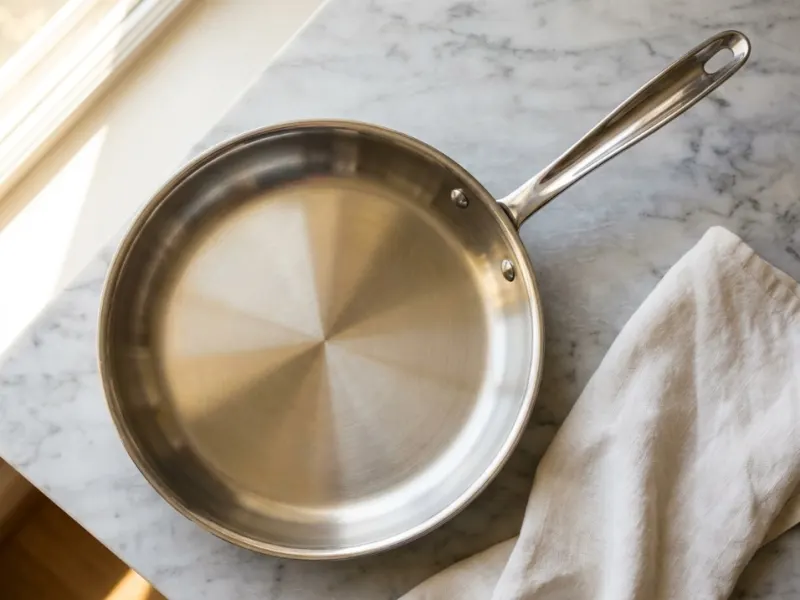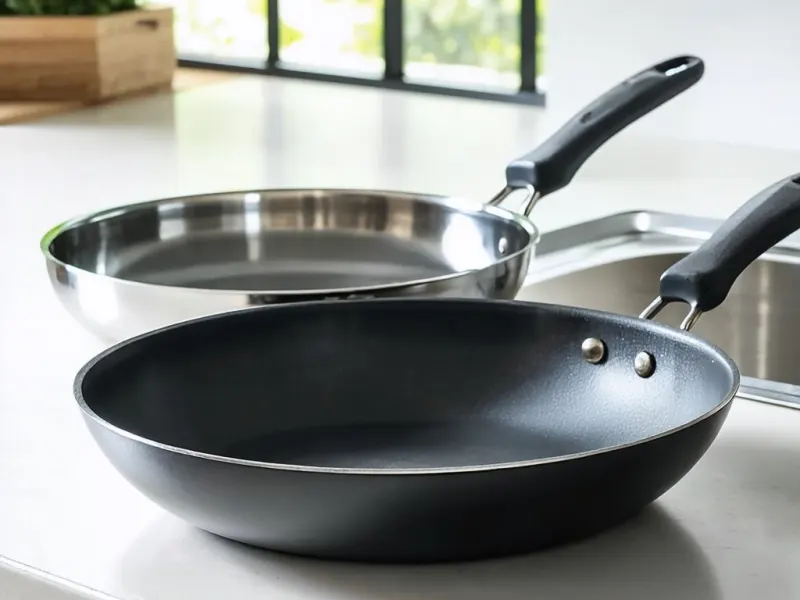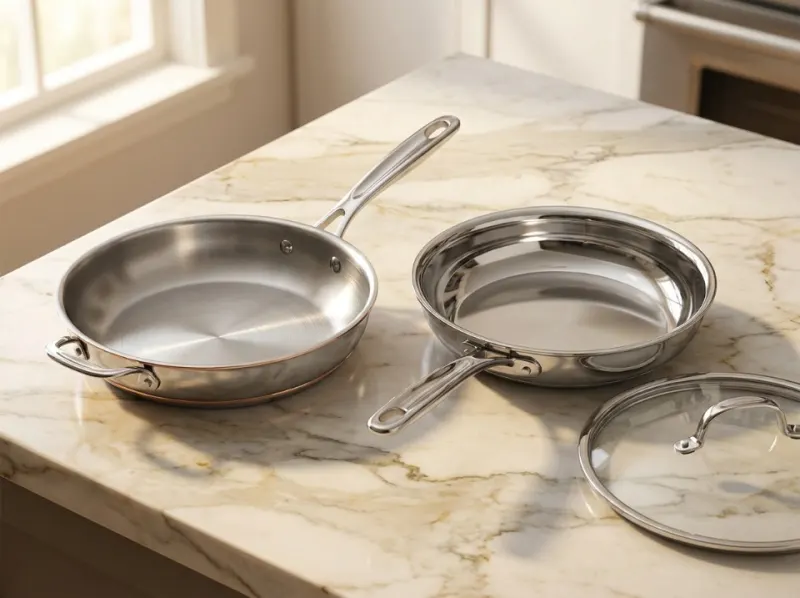
You're standing between a Cuisinart skillet at one price and an All-Clad at roughly 5.5 times the price. Every comparison you've read so far just restates the spec sheet. Then it tells you to buy All-Clad if you can afford it.
All-Clad's Copper Core earns its price with a real construction difference. Its copper-and-aluminum core is bonded rim to rim, up the sidewalls, not just at the base. Cuisinart's Chef's Classic Stainless, the line most budget comparisons pit against it, skips that. Its aluminum only reaches the base.
That's not a brand-prestige gap between two otherwise similar pans. It's a different category of construction entirely, one that spans well beyond these two brands, as our stainless steel cookware guide lays out. It only matters for certain kinds of cooking.
That question sent us back to both brands' own product pages and comparison guides, past the usual spec-sheet recap. Most existing comparisons skip one thing: the classic apples-to-apples pairing, All-Clad D3 against Cuisinart's own fully clad MultiClad Pro, isn't as easy to find anymore. What we found changes the actual question here.
What "Fully Clad" Means, and Why Chef's Classic Stainless Skips It#
Stainless steel alone conducts heat poorly, which is why almost every mid-range and premium pan bonds in a more conductive metal, usually aluminum or copper, sandwiched between two layers of steel.
The real question isn't whether that metal exists. It's how much of the pan it actually covers.
All-Clad's own product page describes Copper Core the way you'd expect from the name: a fully bonded copper core that "extends rim to rim," reaching up through the sidewalls, not stopping at the base. That's the textbook definition of fully clad construction. Our deep dive on 3-ply versus 5-ply construction covers why that matters more than layer count on its own.

Cuisinart's own comparison guide describes Chef's Classic Stainless differently. Their exact words: "Instead of full cladding, these pieces use an aluminum-encapsulated base to promote even heating where it matters most." Cuisinart isn't hiding this. They pitch it as a feature, an approachable entry point to stainless cookware, not a fully clad pan sold at a discount.
That's the real dividing line here. It has nothing to do with which name is more recognizable.
The Test That Actually Decides This#
Forget "can you afford All-Clad." The real question is narrower. Does your cooking ever ask the sidewalls of the pan to do work?
Think about deglazing after a sear, or reducing a sauce that climbs partway up the sides and needs even heat the whole way. Think about browning enough food that it piles above the base.
Disk-bottom construction leaves those walls noticeably cooler than the center in every one of those cases. Food touching them cooks slower, and it browns less evenly, because the aluminum core doing the heavy lifting never reaches that high.
Now picture cooking that mostly stays centered on the base: boiling pasta, steaming vegetables, a quick fry for one or two servings. That gap barely shows up there. The base is exactly where Chef's Classic Stainless puts its aluminum. It's genuinely competent at that one job.
That's the honest version of "is the premium worth it." It's not about how much you cook. It's about where on the pan you cook.
Where the Rest of the Spec Sheet Actually Differs#
Past construction, the remaining gaps are smaller, but still real. All-Clad's own product page rates Copper Core oven and broiler safe to 600°F. Cuisinart's own use and care guide caps Chef's Classic Stainless at a lower 500°F ceiling.
Neither ceiling matters much on the stovetop. It matters more under the broiler, where one pan needs no second thought and the other needs a temperature check first.
Copper Core is induction compatible per All-Clad's own product page, and carries All-Clad's Limited Lifetime Warranty from the brand's Pennsylvania factory. Consumer Reports rates Chef's Classic Stainless "fair" for handle sturdiness. That's a little more wobble after a few years of daily use, not a sudden failure. You can see whether the maker rates a given line for induction in our induction compatibility checker.
None of that is where the roughly 5.5-times price gap actually lives. It lives in the sidewalls. Or it doesn't matter to you at all.
The Mistake That's Easy to Make Shopping for Either Brand#
Here's a trap in the fine print, on both sides. "Stainless steel" on the box doesn't tell you which construction category you're getting. Neither does the brand name alone.
Cuisinart sells at least three different stainless steel constructions under confusingly similar names. MultiClad Pro and Custom-Clad 5-Ply are genuinely fully clad, bonded from the base up the sides. Chef's Classic Stainless, the line we've compared here, is not. Check the specific collection name on the listing, never just the material.
When we checked Cuisinart's own site for this comparison, we ran into a second wrinkle that matters if you're cross-shopping against older articles or forum threads. Cuisinart currently lists the 12-piece MultiClad Pro set as discontinued, though it still turns up at some retailers while stock lasts.
Most existing "All-Clad vs Cuisinart" comparisons default to that exact pairing, D3 against MultiClad Pro, because it used to be the obvious apples-to-apples match-up. That comparison may not even be available to you today, which is part of why Chef's Classic Stainless, not MultiClad Pro, has become the realistic budget option.
Who Chef's Classic Stainless Is Actually Right For#
None of this makes Cuisinart the wrong choice for a lot of kitchens. Maybe you're outfitting a first apartment, cooking for one or two people, or you just want a reliable pot for boiling and steaming without a five-times markup.

The aluminum-encapsulated base does the one job it's built for, and does it honestly. Our first-apartment cookware guide covers that lighter-use case in more depth.
Where it costs you is the scenario the construction test above describes. Sauces, reductions, and searing that reach the walls. If that's a regular part of how you cook, the aluminum-encapsulated base works against you every time, not just occasionally.
The All-Clad vs Cuisinart Verdict#
All-Clad's Copper Core is a rare "premium" pan where the price gap maps to something you can actually feel in the food. Cuisinart's Chef's Classic Stainless isn't a lesser knockoff of the same idea, either. It's a genuinely different, cheaper construction that Cuisinart is upfront about, built for a narrower set of cooking tasks.
Does your cooking lean on the sidewalls, sauces, reductions, big sears? Then the fully clad construction earns its premium. If it doesn't, save the difference and put it toward where you'll actually feel a construction upgrade later instead.
Not sure which camp you're in? Our cookware material selector walks through this exact construction trade-off. That 5.5x price gap alone cannot tell you which construction suits your cooking.