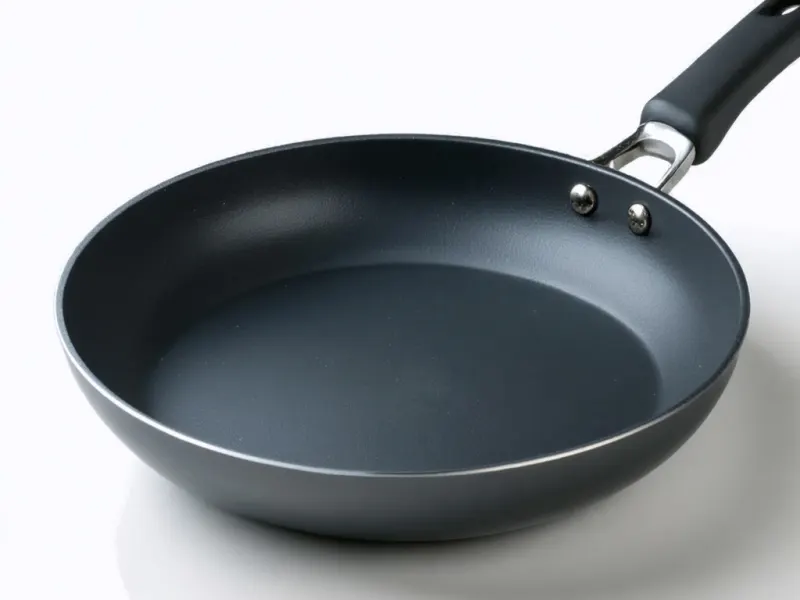
You're weighing an All-Clad nonstick pan against mid-range PTFE options that, as of September 2026, cost noticeably less. One question actually decides whether that gap is worth paying. Does the price buy safer chemistry, or something else entirely?
All-Clad's entire current nonstick catalog, the HA1 Nonstick and the newer NS Pro Ceramic Nonstick alike, is made in China and uses coating chemistry no different or safer than mid-range PTFE pans. The Pennsylvania heritage-manufacturing story belongs to All-Clad's bonded stainless lines, D3 and D5 among them, not to either current nonstick line.
Where a specific brand's coating sits in the bigger picture is only half the decision. Our nonstick cookware buying guide walks through PFAS verification, oven limits, and how long any PTFE or ceramic coating actually holds up.
All-Clad's own product listing and spec pages, read side by side, confirm exactly that, once you know where to look.
The Coating Is Identical to Budget Pans#
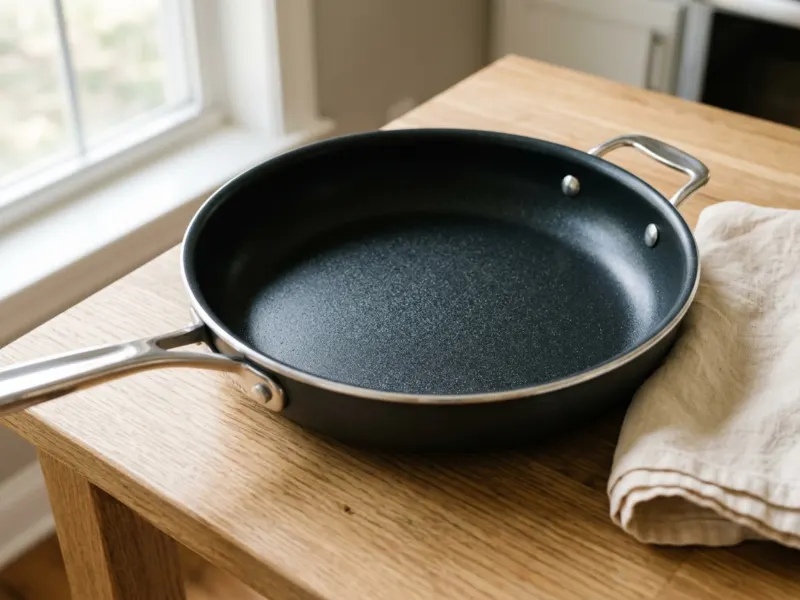
All-Clad's own chemical safety disclosure page states it plainly: its nonstick cookware contains PTFE. The same page notes that PTFE sits on California's Biomonitoring Priority Chemicals list. That's not hidden. Most buyers just never check it.
The HA1 line pairs that same PTFE with a hard-anodized aluminum body. A bonded steel plate on the base makes it induction-compatible, per All-Clad's own product specs.
Competing brands' own nonstick disclosures read nearly the same as All-Clad's. "Multi-layer" and "reinforced" are marketing terms for the same polymer, not a different one.
The way the coating breaks down is the same too. Repeated heating and cooling degrades the same fluorine-based surface chemistry in every PTFE line, and price does not change that chemistry. Owner reports on this exact pan back that up: one buyer logged eighteen months of twice-weekly use, dishwasher top rack, bamboo utensils only, with no scratching or peeling, while another reports it lasts a long time as long as you stick to wood or silicone tools.
What All-Clad's premium actually buys is structural quality, not the handle. The premium shows in the build from day one: owner reports describe it as heavy, flat, and even-heating across the base, a real benefit for anyone who cooks daily.
The handle is a genuine tradeoff, not a benefit. Owner reports describe it as awkward to hold, with a helper handle on the opposite side that one buyer found very helpful. In at least one case it felt bad enough on the first grip that the pan went back unused. That reviewer ordered All-Clad's own HA1 Expert Nonstick instead, saying in their own words it "appears to have a better designed handle." Neither the base's heft nor the handle's shape touches the coating's safety profile.
All-Clad's 'Made in Pennsylvania' Story Doesn't Cover Either Nonstick Line#
All-Clad's stainless lines lean hard on a heritage-manufacturing story. It's a real one. The company's own D3 product page states the cookware is "Made in the USA with global components in our Pennsylvania Factory since 1971." That same page rates the stainless line oven and broiler safe to 600°F.
That heritage story is part of what justifies paying more for a D3 skillet over a budget tri-ply pan.
Neither of All-Clad's current nonstick lines carries that same story. All-Clad's own spec table for the All-Clad HA1 fry pan lists China as where it's made, and its Amazon listing spells it out just as directly: designed in Canonsburg, Pennsylvania, but made in China. The newer NS Pro Ceramic Nonstick line carries the same disclosure, covered in full below. Our full breakdown of where every current All-Clad line is made lays out the per-line origin split, stainless and nonstick alike, in one place.
Coverage of this exact question tends to treat "is All-Clad nonstick safe" as a brand-wide question. It doesn't zoom in on where either current nonstick line is actually built.
That gap matters. The heritage story is one of the few non-chemistry reasons to pay more for All-Clad, and on either current nonstick line, HA1 Nonstick or NS Pro Ceramic Nonstick, that reason doesn't apply. Neither does the coating-chemistry reason for the PTFE line. Neither does the shorter warranty term for the ceramic one.

Is All-Clad Non Stick Safe? It Comes Down to Temperature#
The actual safety question is about heat, not brand. PTFE is chemically inert at normal cooking temperatures. According to the FDA's food-contact substance regulations, PTFE is approved for food contact. Separately, the Missouri Poison Center notes that accidental ingestion isn't a danger either: a flake, if swallowed, travels through the intestines and comes out in the stool intact without causing harm.
The real risk is the coating breaking down under heat, and that only happens well past where any recipe needs the pan to go.
The NCBI's StatPearls reference on polymer fume fever puts the numbers precisely. Symptoms generally don't start until PTFE hits 662°F, and full breakdown starts at 752°F.
All-Clad rates the HA1 oven-safe to 500°F, per its own product listing. That's roughly where fume release can begin. The real margin sits between that number and 662°F, where human symptoms actually start. Even then, per the NCBI's own StatPearls reference, the typical course of polymer fume fever is mild and self-limited.
Reaching that danger zone means leaving an empty pan on high heat for a long stretch, well past any normal cooking use. With food, oil, or liquid in the pan, the thermal mass keeps surface temperatures far under the line.
That threshold is chemistry. Chemistry doesn't check the price tag. A mid-range PTFE pan and a premium-priced All-Clad reach the same danger zone at the same number.
The PFOA Question Is Already Resolved#
Part of what drives the "is it safe" search is confusion between PTFE and PFOA. PFOA, perfluorooctanoic acid, was a processing chemical used during PTFE manufacturing for decades. It's the one with real documented health concerns.
The EPA's PFOA Stewardship Program got manufacturers to commit to removing PFOA from emissions and products, with the full phase-out completed by 2015. Most nonstick pans sold today, All-Clad's included, are PFOA-free, though Consumer Reports lab-tested a PTFE pan labeled PFOA-free and found an average of 4 parts per billion of PFOA in it anyway, a gap serious enough that CR now leaves PFOA-free claims out of its own nonstick ratings entirely.
PFOA-free is not the same claim as PFAS-free, and that distinction is where most of the confusion actually lives. PTFE itself is a PFAS compound, a fluorine-carbon backbone, regardless of whether PFOA was ever part of making it. A PFOA-free label on a PTFE pan answers a narrower question than it sounds like. It means the manufacturing byproduct is gone, not that the coating falls outside the PFAS family altogether.
Leftover PFOA near older factories is a real environmental problem. It's not one that lives inside a pan bought after 2015. The broader PFAS worries still floating around online are mostly about factory runoff into water supplies, not about cooking with a finished, PFOA-free pan at home. If skipping fluoropolymer chemistry entirely, not just PFOA, matters to you, stainless steel sidesteps the coating question altogether.
If You're Weighing All-Clad's Ceramic Line Instead#
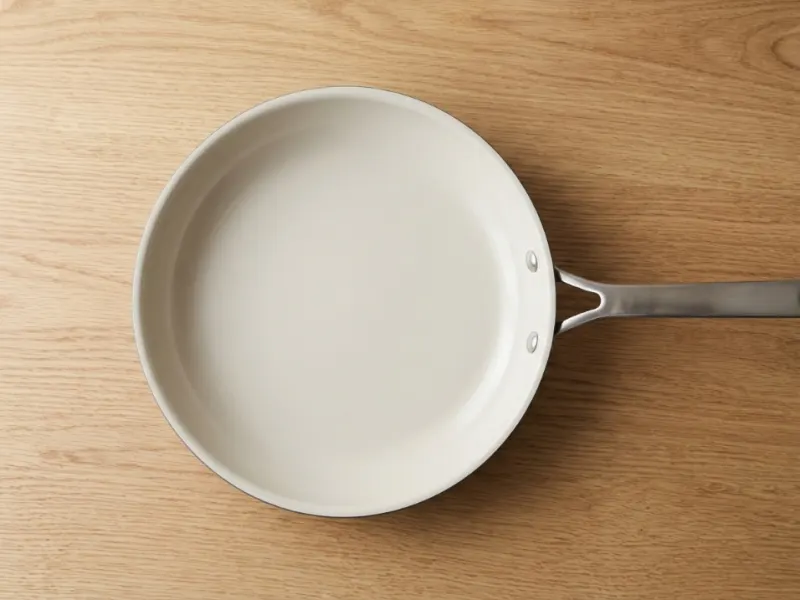
All-Clad's own current lineup includes a line worth weighing separately: the newer NS Pro Ceramic Nonstick, a current line on All-Clad's own site as of September 2026, not a discontinued experiment. It swaps PTFE for a mineral-based sol-gel coating with no PTFE or PFOA in it. Ceramic genuinely can't release polymer fumes at any temperature.
The spec sheet has its own tradeoffs, though, and they mostly run in the HA1 Nonstick's favor. NS Pro Ceramic Nonstick tops out at 450°F in the oven, fifty degrees below the HA1 Nonstick's 500°F ceiling. Its glass lid caps out at the same 350°F the HA1's does. All-Clad's own care instructions for the ceramic line go further and rule out the broiler entirely, a restriction the HA1 Nonstick doesn't carry.
Warranty coverage draws the same line: NS Pro Ceramic Nonstick carries a 1-Year Limited Warranty, against the HA1 Nonstick's Limited Lifetime Warranty. That's a real coverage gap straight from All-Clad's own terms, worth weighing on its own. It states what All-Clad is willing to cover, not a verified measurement of how long either coating actually lasts.
Durability is the real tradeoff, and it's not a small one. On Amazon, one GreenPan ceramic owner review reports losing release within about six months. A separate GreenPan owner reports it lasting around a year and a half instead. Both are individual reports on a named platform, not a composite ceramic-category figure.
The HA1 Nonstick runs the same PTFE coating chemistry as mid-range pans, so there's no reason to expect a different wear timeline. That's a chemistry inference, not an owner-reported finding. No HA1-specific coating-lifespan report exists in the record.
Mid-range PTFE pans have their own reported spread on Amazon. Some owners lose release in as little as a year. Others report 4-5 years with careful use. A Reddit r/Cooking thread on a budget PTFE pan reports about five years with careful use, corroborating that habits, not price tier, drive how long PTFE actually lasts.
The NS Pro Ceramic Nonstick line carries the same Canonsburg-designed, made-in-China disclosure covered above, so switching to ceramic does not buy the Pennsylvania story either.
If you already read that ceramic is safer than Teflon, here's the fuller picture: ceramic wins on chemistry, not on how long the coating actually holds up.
The Bird Exception#
Pet birds are the one genuine safety concern with PTFE cookware at home. It doesn't depend on price or brand. According to a peer-reviewed veterinary case report, birds are far more sensitive than humans to inhaled toxicants. That's due to how efficient their respiratory systems are.
That same report puts the surface-degradation threshold for birds at 536°F (280°C), below the 662°F point where human symptoms begin. VCA Animal Hospitals documents PTFE poisoning cases in birds even at recommended, not just overheated, cooking temperatures.
If you keep birds, any PTFE pan carries this risk regardless of how much it cost. Stainless steel or well-seasoned cast iron is the safer call.
What We'd Actually Recommend#
The short answer: yes, it's safe. Buying the All-Clad HA1 for its build quality is a perfectly reasonable call. Nothing about the coating chemistry, the 500°F rating, or the wear timeline makes this pan riskier than mid-range PTFE cookware that, as of September 2026, costs less.
What the premium doesn't buy is safer chemistry. The HA1 Nonstick uses identical PTFE to less expensive pans, hits the same 500°F ceiling, and, since the coating chemistry is the same, there is no reason to expect it to outlast other PTFE pans. If you want this pan for the construction, a heavy body and an induction plate that works cleanly on glass-top stoves, that reasoning holds up.
Paying more for it doesn't put you at any extra risk. The handle itself is a real tradeoff owner reports flag, though, not a reason to pay more. It's also worth knowing All-Clad's whole current nonstick catalog, HA1 Nonstick and NS Pro Ceramic Nonstick alike, is built in China rather than at All-Clad's Pennsylvania plant, unlike the brand's stainless lines, if that heritage detail matters to you.
The one case where the extra spend buys nothing at all: if construction isn't part of what you want and price is the only variable in play. A less expensive nonstick pan with the same PTFE coating carries an identical safety profile for less money as of September 2026.
If nonstick safety is what's actually worrying you regardless of which pan you land on, the fix isn't a pricier PTFE pan. It's temperature discipline: medium heat maximum, never preheat empty, never run high without food in the pan. Our cookware safety checker tracks which of these are genuinely PFAS-free, with the evidence behind each verdict.
Or it's switching materials entirely. A hard-anodized pan's safety profile depends on its coating, not the anodized layer underneath it. Stainless steel and well-seasoned cast iron carry zero coating concerns and last decades. Our cookware cost calculator compares repeat nonstick purchases with one uncoated pan.