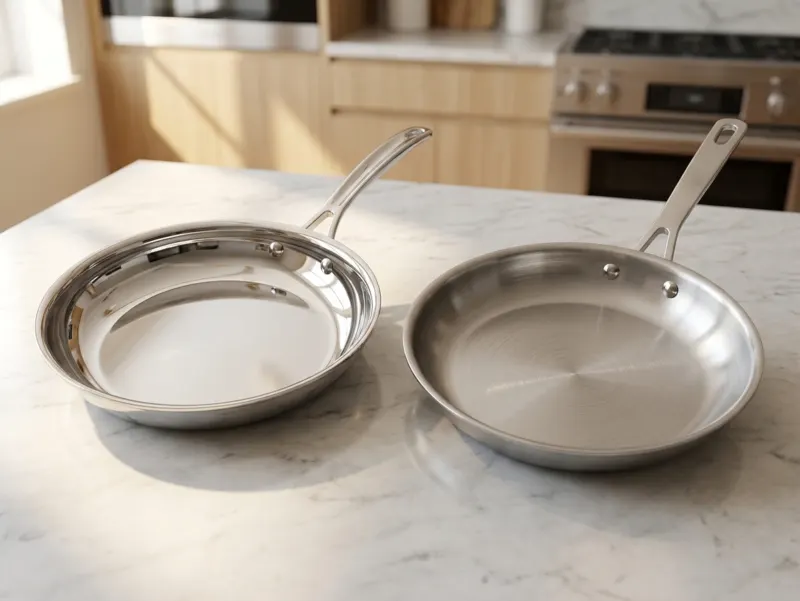
You are standing in a store holding two stainless steel pans. One says 3-ply on the tag. The other says 5-ply and costs meaningfully more.
The marketing suggests more layers equal better cooking. The physics say otherwise.
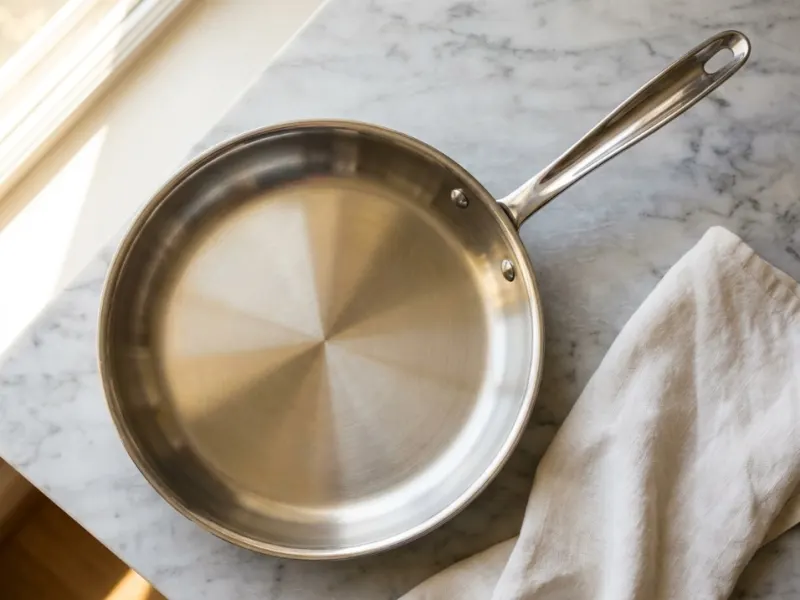
The number of layers in a stainless steel pan does not determine how well it cooks. Total aluminum thickness and whether the pan is fully clad (aluminum running from base to rim) are what control heat distribution. A quality 3-ply pan like the Cooks Standard Multi-Ply Clad 12-inch, priced in the budget tier, uses the same fully-clad physics as pans costing several times more.
Our stainless steel cookware guide walks through the rest of the buying decision once construction is settled: induction contact, maintenance, and when a premium brand is actually worth the spend.
The layer count is a manufacturing detail, not a performance spec. The Cooks Standard Multi-Ply Clad 12-inch is fully-clad tri-ply at a fraction of what premium 5-ply alternatives charge for the same underlying thermal physics.
That raises a question most shoppers never think to ask. If ply count does not determine cooking performance, what does? We dug into NIST thermal conductivity data, manufacturer statements, and owner reports across tens of thousands of Amazon reviews to find the answer.

What 3-Ply and 5-Ply Construction Actually Means#
Stainless steel on its own is terrible at moving heat around. According to NIST reference data, aluminum moves heat about 16 times faster than stainless steel (237 versus 14.9 watts per meter-kelvin). Copper does even better at roughly 27 times the rate of stainless, which is why it shows up in premium lines.
Makers fixed this heat problem by bonding layers together. A 3-ply pan sandwiches one aluminum core between two stainless steel layers. The outer steel layer gives you durability and (when it uses 430 ferritic stainless) works on induction cooktops.
The interior stainless gives you a non-reactive, food-safe cooking surface. The aluminum in the middle handles nearly all heat distribution.
A 5-ply pan adds two more layers, typically alternating stainless and aluminum. All-Clad's own D5 line describes this as five-ply with alternating steel and aluminum layers, aimed at slightly more even heating at the cost of extra weight.
Why Total Aluminum Mass Matters More Than Layer Count#
Here is why the ply debate does not matter for your cooking. Whether the aluminum sits as one thick layer or two thinner layers adding up to the same total mass, it moves heat the same way. You cannot split 237 watts per meter-kelvin into more layers and get extra. The heat goes through the same metal mass either way.
What DOES change your cooking results is total aluminum thickness. A heavy 3-ply pan with a thick core will outperform a thin 5-ply pan that spreads less metal across more layers. When you pick up a pan, weight tells you more than the ply number printed on the box.
The Question That Actually Changes Your Cooking: Disc-Bottom vs Fully Clad#

This is the distinction you will feel at the plate. In a fully-clad pan, the aluminum core runs from the base all the way through the sidewalls. Every surface that touches food conducts heat.
In a disc-bottom pan, a metal disc is bonded only to the base. The sidewalls above are bare stainless steel with that 16x conductivity penalty.
You will notice the gap in any cooking beyond shallow frying. Sauces pooled against the edge of a disc-bottom pan reduce slower than in the center. Vegetables near the wall cook at a different rate than those in the middle.
Pan sauces deglaze unevenly. For building a fond or braising, fully-clad construction cooks noticeably more evenly.
Many budget stainless pans sold in department store sets are disc-bottom despite looking identical to fully-clad pans from the outside. Here is a simple buying test you can use in any store or from any product listing:
- Check the rim. Visible distinct metal layers at the lip = fully clad.
- A single-sheet rim with no layering visible = likely disc-bottom.
- Online, look for "fully clad" or "clad from base to rim." Listings that only say "stainless steel" without specifying construction are almost always disc-bottom.
We wrote about why food sticks to stainless steel from a technique perspective. Construction plays a role too. A disc-bottom pan with uneven heating makes proper preheating harder because parts of the cooking surface reach temperature while others lag behind.
When 5-Ply Earns Its Price#
We do not dismiss 5-ply entirely. The extra mass and thermal stability help in two specific situations.
Heavy-duty braising and slow sauteing benefit from a pan that holds temperature when cold food hits the surface. If you regularly sear thick proteins and build a pan sauce in the same pan, that extra thermal mass means less temperature drop on contact. The pan recovers slightly faster because it stored more energy.
The added weight also provides stability on smooth cooktops. A heavier pan sits flatter and resists movement during aggressive stirring. On glass-top stoves, stability matters because a wobbling pan loses contact with the heating element.
These are marginal gains. A thick, well-built tri-ply pan provides most of the same thermal mass. The layer count itself is not delivering the benefit. The total weight and thickness of conductive material is what matters, regardless of how many layers it happens to be divided into.
The Buying Framework We Actually Use#
When we evaluate a stainless pan, three questions determine whether it cooks well. None of them involve counting layers.
- Is it fully clad or disc-bottom? Fully clad is the better construction for all-purpose cooking. The rim test and listing-phrase check from the section above are the fastest way to verify.
- What does it weigh? A substantial pan with a thick aluminum core heats more evenly and holds temperature better than a thin one, regardless of ply count. Compare it against a pan of the same diameter. A noticeably lighter, hollow-feeling pan usually means a thinner core.
- Does the handle work for your cooking? Budget tri-ply pans without a helper handle create real torque when the pan is loaded with food and its lid. If you cook daily and flip by tossing, handle ergonomics matter more than an extra ply.
For most home cooks, a quality fully-clad tri-ply pan delivers everything you need. The Cooks Standard Multi-Ply Clad 12-inch uses 430 ferritic stainless for induction compatibility and costs a fraction of premium 5-ply alternatives with the same underlying physics.
Its main documented weak point is the missing helper handle rather than the core construction: one owner reported a warped bottom after a year of use, a failure mode any thin-gauge pan risks under enough thermal shock regardless of brand. If a helper handle and a heavier build matter more to you than the price gap, that trade-off is worth paying for. We compared the physics of stainless steel construction against hard-anodized alternatives in a separate breakdown if you are weighing different materials entirely.